Coach crash in the Ain: two dead, including a child. Must coach passengers in France wear a seat belt, what is the fine, and what rights does an EU long-distance coach passenger have
On Friday 6 November a coach travelling from Lyon to Bourg-en-Bresse crashed in the Ain. What French rules say about seat belts on coaches, how much the fine is, and what EU law guarantees a passenger after a cancellation, a delay or an accident.
What happened
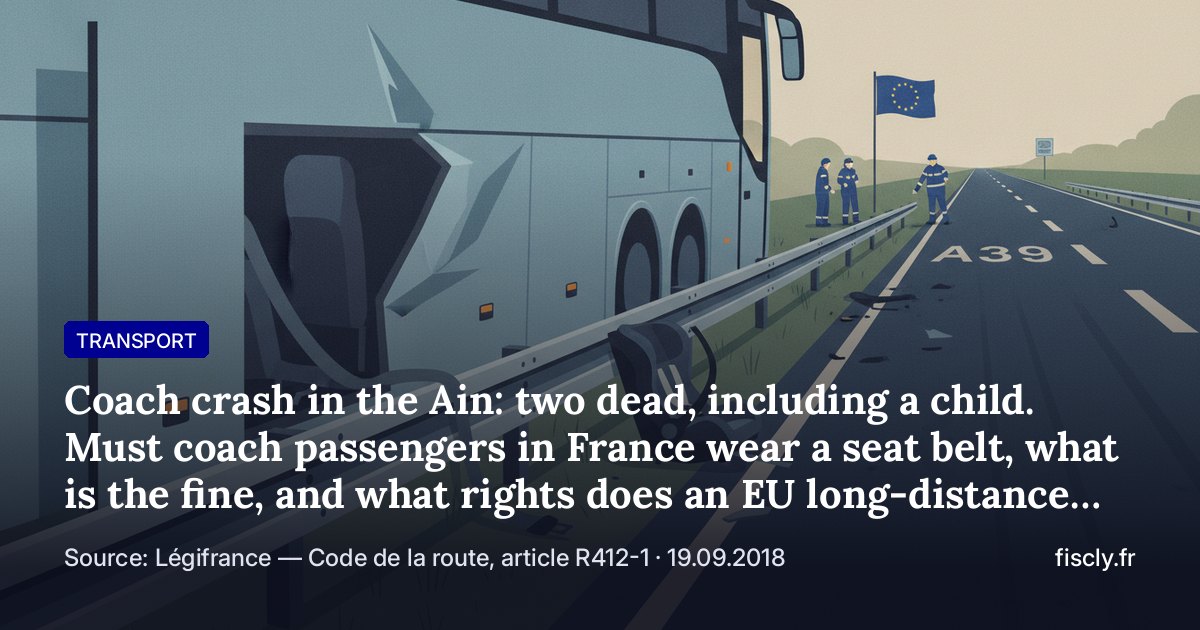
On Friday 6 November a long-distance coach travelling from Lyon crashed in the Ain département, near Bourg-en-Bresse. According to franceinfo, two people died, among them a seven-year-old girl. The driver said he had fallen asleep at the wheel. His first alcohol and drug tests were negative, the investigation is ongoing, and the cause of the crash has not been officially established.
The investigation will establish what happened on the road, and we will not speculate. But many of our readers take long-distance coaches within France and abroad, and their children ride school coaches. So here is what the rules ask of the passenger, and what the passenger is guaranteed.
Seat belts on a coach: yes, if the seat has one
Article R412-1 of the Code de la route (version in force since 19 September 2018) requires every driver or passenger of a motor vehicle on the road to wear an approved seat belt when their seat is fitted with one. There is no separate exception for coaches. If your seat has a belt, the rule applies on a coach just as it does in a car.
The article does list exemptions. They include people whose build makes a belt unsuitable, and people holding a medical exemption certificate. If a seat has no belt, there is no obligation to wear one.
How much the fine is
Breaking R412-1 is a 4th-class offence (contravention de 4e classe). According to the service-public page "Amende forfaitaire en cas de contravention au code de la route" (checked on 11 January 2025), the amounts for this class are:
- €90 (minorée), if paid on the spot to the officer or within 15 days, or within 30 days when a notice sent to your home is paid online by card;
- €135 (forfaitaire), within 45 days, or 60 days when paid online by card;
- €375 (majorée), if the €135 is not paid in time.
Under R412-1, three licence points are deducted only when the driver is the one not wearing a belt. A passenger pays the fine but loses no points.
Children on a coach
In a car, article R412-2 applies: a child under 10 must travel in a child restraint suited to their size and weight, and the driver is responsible for this. But a child carried in a taxi or a public transport vehicle (véhicule de transport en commun) is exempt from the child-restraint requirement. The part of R412-2 that makes the driver responsible for passengers under 18 covers vehicles with no more than nine seats, so it does not apply to a coach. The general belt rule still applies, because R412-1 covers every passenger. When travelling with children, check that the belt is fastened and sits properly.
Passenger rights on long-distance coaches in the EU
In the EU, bus and coach passenger rights are set by Regulation (EU) 181/2011, which has applied since 1 March 2013. According to the official summary on EUR-Lex:
- the full set of rights applies to regular services of 250 km or more, and some provisions apply to all services;
- in the event of cancellation, overbooking or a departure delay of more than 120 minutes, the carrier must offer a choice between continuing the journey, rerouting or a refund;
- if the journey is cancelled and no such choice is offered, the passenger is entitled to compensation of 50% of the ticket price;
- for delays of more than 90 minutes on journeys of three hours or more, passengers get assistance: snacks, meals and, where needed, a hotel for up to two nights;
- passengers are protected against injury and against loss of or damage to luggage in a road accident, and compensation is due in case of death;
- carriers must run a complaint-handling mechanism that is accessible to all passengers.
In practice, keep your ticket or booking confirmation, and note the time a delay was announced. Without them, your rights are harder to prove.
What this means
- If your coach seat has a belt, buckle up. It is the law, not just the operator's preference, and the passenger pays the fine.
- If you are fined, the reduced amount has a short window: 15 days, or 30 days when a notice is paid online by card.
- On long-distance EU routes, a delay of more than two hours gives you a choice between rerouting and a refund. This is a rule, not a courtesy from the operator.
The text of the articles is on Legifrance, the fine amounts are on service-public, and passenger rights are in the EUR-Lex summary of Regulation 181/2011. Links below.
Fiscly is an educational tool to help you understand the French tax system. It is not a substitute for professional tax advice. Tax situations are individual — always verify with impots.gouv.fr or a qualified accountant (expert-comptable) for your specific case.