Cyberattack on Guadeloupe's university hospital: plan blanc triggered on 22 November 2026, planned care partly postponed until 27 November. What a plan blanc means for patients and when to call 15 first
After a cyberattack on 21 November 2026, the CHU de Guadeloupe switched to its plan blanc crisis mode. What this means for patients, why you are asked to call 15 before going to A&E, and which emergency numbers apply in France.
What happened
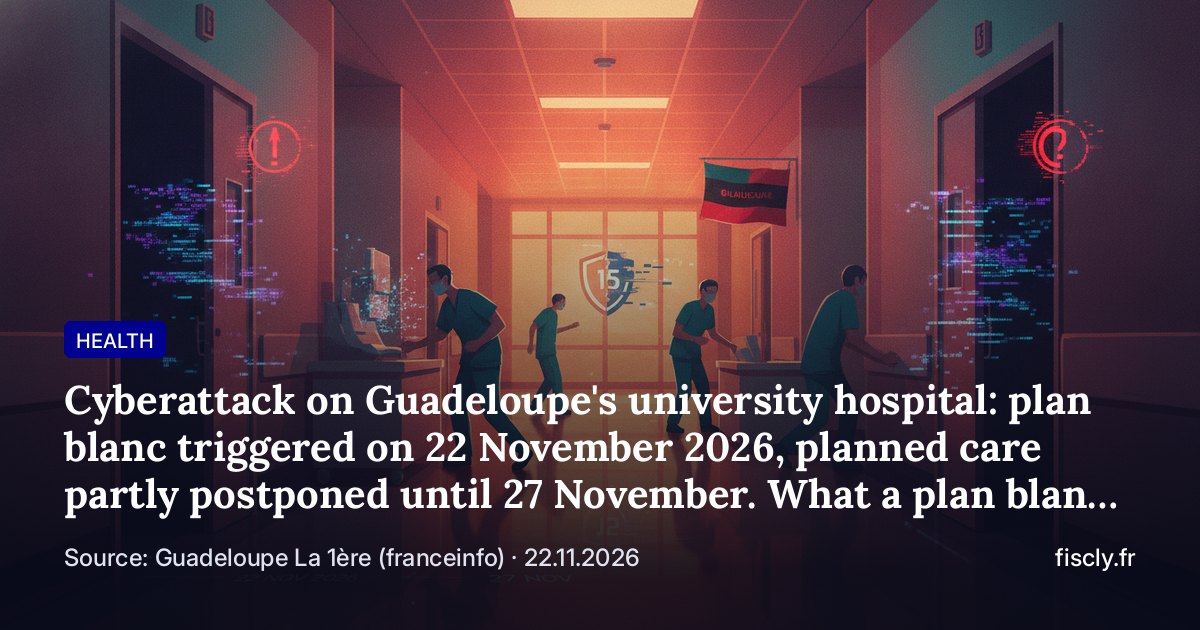
Since Saturday 21 November 2026, Guadeloupe's university hospital (CHU de Guadeloupe) has been operating after a cyberattack that hit its information system and its phone lines. On Sunday 22 November the hospital's crisis team triggered its plan blanc, a special operating mode for emergencies. Guadeloupe La 1ère (franceinfo) reports this, citing the hospital's management.
What is known at the time of publication:
- some planned operations, consultations and scheduled imaging exams are being pushed back, up to and including Friday 27 November;
- urgent and priority care continues;
- ANSSI, the national cybersecurity agency, is involved in restoring the systems;
- the move of paediatric emergency care to the Belle-Plaine site, scheduled for the night of 23 to 24 November, goes ahead;
- the head of the SAMU advises residents not to come to the hospital without first calling 15.
No extension of these dates has been announced so far. If you have an appointment or procedure at the CHU in these days, it makes sense to check whether it is still on.
What a plan blanc is
Every healthcare establishment in France has its own crisis plan, the plan blanc d'établissement. Among its legal bases, the official portal sante.fr lists Article L3131-7 of the Public Health Code (Code de la santé publique). As the portal describes it, the plan is designed for an influx of patients or an exceptional health situation and lets the hospital immediately draw on all its resources. It sets out how needed staff can be kept on site or called back; resources are brought in step by step, sector by sector. A crisis cell is set up, led by the head of the establishment.
The hospital director triggers the plan and informs the State's representative in the department without delay; that representative can also ask for it to be triggered.
For patients, it usually means one thing: the hospital concentrates on urgent cases, and planned care can wait. A cyberattack is only one possible trigger: the plan is used whenever a hospital cannot cope in normal mode. So when you see news of a plan blanc anywhere in France, read it as a signal: for the next few days, avoid going to that hospital unless you really have to, and call 15 first.
Why you are asked to call 15 first
15 is the number of the SAMU, the emergency medical service. According to service-public.gouv.fr, it is the number for a medical emergency; it is also how you reach the Service d'accès aux soins (SAS), the care access service.
In 2022 the health ministry launched a campaign called "Avant d'aller aux urgences, appelez le 15": call 15 before heading to the emergency department (urgences), so it is not overloaded. Urgences are for the most serious cases. The campaign lists reasons that do not justify going there:
- a medical certificate for sport;
- renewing a prescription;
- a vaccination;
- extending sick leave (arrêt de travail);
- an X-ray without a prescription;
- a pregnancy test without abnormal symptoms.
For such cases the campaign suggests calling your regular doctor (médecin traitant) during the day, looking for a teleconsultation, contacting the SAS, or calling SOS Médecins.
Other numbers worth knowing
From the service-public.gouv.fr directory (checked 25 August 2026):
- 112: the European emergency number; your call is routed to the right service;
- 18: fire brigade (danger, accident);
- 17: police;
- 114: emergency line for deaf, hard-of-hearing and aphasic people (via app, website or SMS);
- 116 117 is mentioned in the directory as the national number for out-of-hours medical care (permanence des soins).
The basic rule is simple: if a life may be at risk, or you cannot tell how serious it is, call 15 or 112. The person on the line will listen and tell you where to go.
This is general information, not medical advice.
Fiscly is an educational tool to help you understand the French tax system. It is not a substitute for professional tax advice. Tax situations are individual — always verify with impots.gouv.fr or a qualified accountant (expert-comptable) for your specific case.