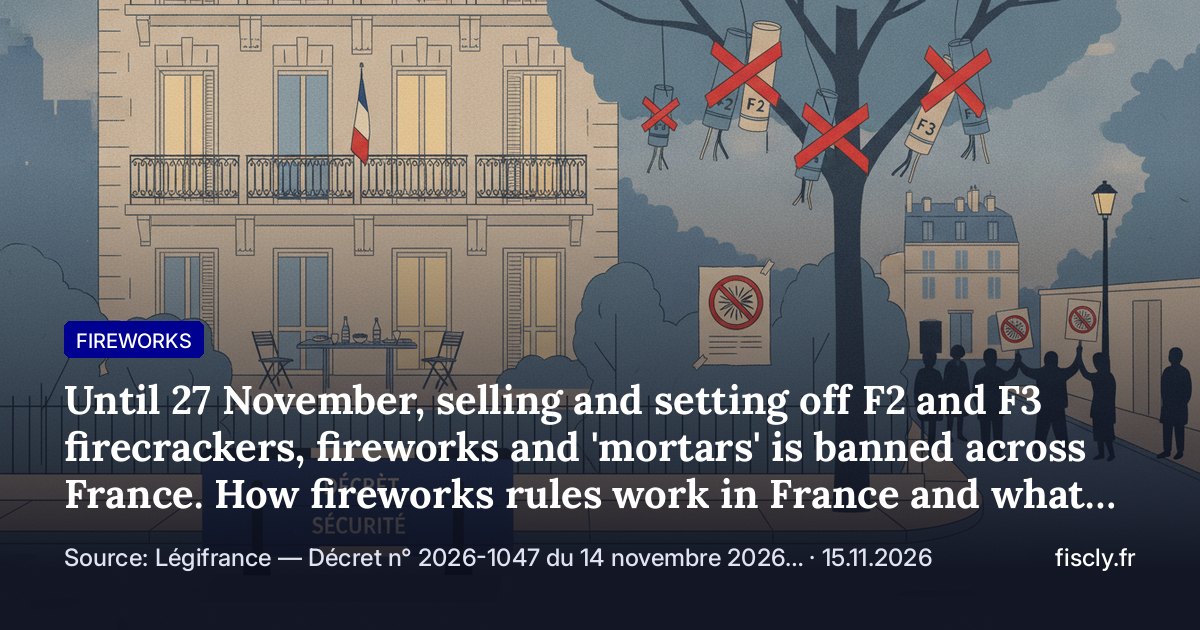
Until 27 November, selling and setting off F2 and F3 firecrackers, fireworks and 'mortars' is banned across France. How fireworks rules work in France and what this means for a party in your garden
Decree no. 2026-1047 was published in the Journal officiel on 15 November and applies immediately. What is banned, who is exempt, how categories F1–F4 differ, and what to check before buying fireworks in France.
What happened
The Journal officiel of 15 November 2026 carries Decree no. 2026-1047 of 14 November, signed by Prime Minister Sébastien Lecornu. It took effect immediately on publication.
The decree bans the sale and use of a list of pyrotechnic articles throughout France until 27 November inclusive. The list covers category F2 and F3 items: firecrackers (fuse-lit, black-powder, flash-composition, and aerial double-bang ones), batteries and combinations, rockets, Roman candles and single-shot candles, firework 'compositions', and the pot à feu en mortier — what people usually call 'mortars'.
The decree states its own purpose: to prevent the risk of serious public-order disturbances linked to the use of pyrotechnics during the blockades outside lycées and universities and during demonstrations.
Who is exempt. The ban does not apply when the items are acquired and used by professionals holding the required approvals, or by public authorities (collectivités publiques). A town display run by the mairie with a certified pyrotechnician is not banned by the decree.
What the text does not say. The decree covers only sale and use: it says nothing about possession or transport. Nor does it name a penalty. There is no exception for private property: the ban applies 'on the whole national territory', your own garden included.
What it means in practice
- If a wedding, birthday or family celebration with fireworks was planned for the coming days, F2 and F3 items can be neither bought nor set off until 27 November inclusive. Options: move the display, or hire a professional pyrotechnician.
- Category F1 is not on the list.
- A shop that keeps selling these items before the ban ends is breaching the decree. Buying 'for later' is not possible either: the sale itself is banned.
- On top of the national decree, local restrictions exist too. The sante.fr page notes that a mayor or prefect can restrict sales to unaccompanied minors. On protest days, prefectures issue their own arrêtés — as in the Var on 7 November. Before buying, check your prefecture's website (
<département>.gouv.fr) and your mairie.
How fireworks are regulated in France: the basics
The rules sort consumer fireworks into four categories — F1, F2, F3 and F4 — by level of danger and noise. Minimum ages for sale (per the sante.fr page, DGCCRF content):
| Category | Minimum age to buy |
|---|---|
| F1 | 12 |
| F2 and F3 | 18 |
| F4 | 18, and only for people with specific knowledge |
What the official page advises checking:
- the CE marking — mandatory on consumer fireworks since 4 July 2010;
- instructions in French — avoid products without them;
- the label: age limit, category, safety distance, whether indoor use is allowed;
- the weather: wind can carry burning debris onto dry grass and start a fire;
- notify your mairie and the local fire station (centre de secours du SDIS) before setting off fireworks on private land;
- your neighbours: noise complaints, the page says, are common.
The same page explains why this matters: pyrotechnic substances are often explosive, can injure, burn and start fires, and children playing with lit firecrackers lose fingers.
What next
The decree runs until 27 November inclusive. At the time of writing, no extension or further measure had been announced. New decrees are published on Legifrance — the place to check whether anything has changed for your date.
This is general information about the rules, not legal advice.
Fiscly is an educational tool to help you understand the French tax system. It is not a substitute for professional tax advice. Tax situations are individual — always verify with impots.gouv.fr or a qualified accountant (expert-comptable) for your specific case.