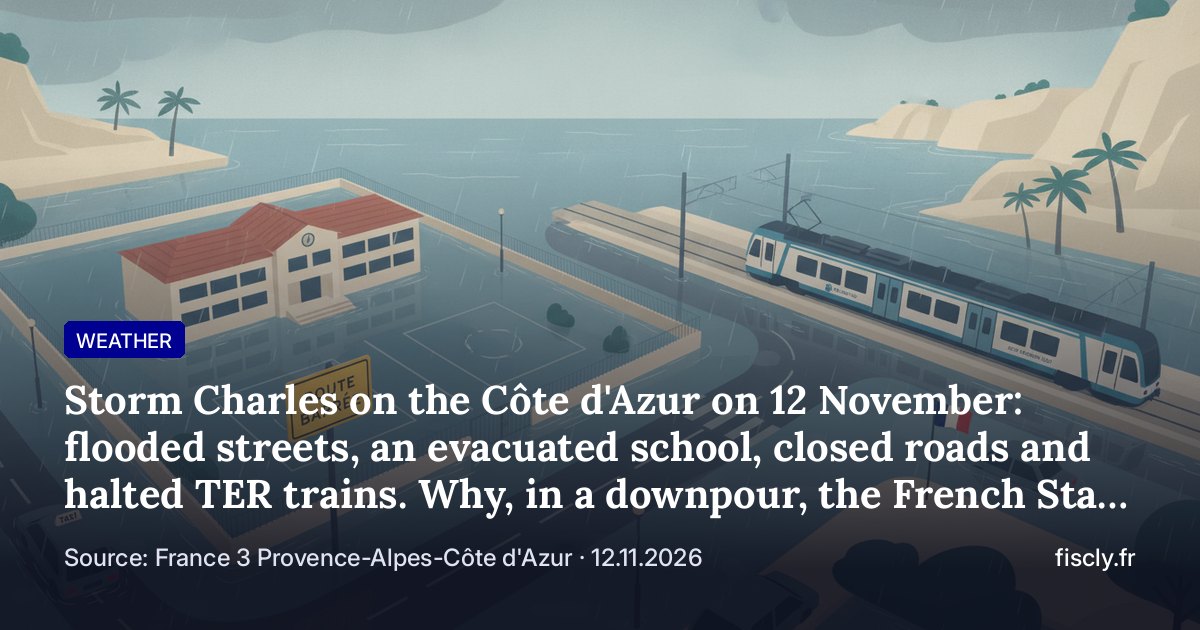
Storm Charles on the Côte d'Azur on 12 November: flooded streets, an evacuated school, closed roads and halted TER trains. Why, in a downpour, the French State asks you not to collect your children from school or get in the car
On 12 November Storm Charles brought heavy rain to the Alpes-Maritimes and the Var: a school was evacuated in Mandelieu, people were caught in a river in Nice, roads and TER lines were shut. Here are the official rules for heavy rain and flooding: what to do about children, the car and the phone, and where to find warnings.
What happened
On Thursday 12 November, Storm Charles swept across the Alpes-Maritimes and the Var. Météo-France kept both departments at yellow level for rain and flooding, thunderstorms and waves. That is not the top level, yet the effects were very real. According to France 3 Provence-Alpes-Côte d'Azur, citing the prefectures, fire services, town halls and SNCF:
- in Mandelieu-la-Napoule the town centre flooded and one school was evacuated as a precaution: the children were moved to town-hall premises, where their parents then collected them;
- in Nice several people ended up in the Paillon river: two were pulled out by firefighters, the others got out by themselves;
- in Grasse part of a house roof collapsed and two residents were brought out;
- in Fréjus people living in part of one neighbourhood were asked to leave their homes; in the Var firefighters got drivers out of cars stuck in water;
- coastal roads near Menton, Roquebrune-Cap-Martin and Èze were closed, as were sections of road and motorway near Fréjus in the Var;
- TER trains stopped between Cannes and Grasse and between Les Arcs-Draguignan and Cannes. SNCF said service was being restored from 16:00, with the normal timetable expected around 18:00.
For the current situation, check the map at vigilance.meteofrance.fr and vigicrues.gouv.fr: levels change during the day.
Why this is not only a southern story
According to the Ministry for Ecological Transition, the Mediterranean arc is the area most exposed to intense rain: the Gard, Ardèche, Hérault and Lozère top the list for days with more than 200 mm. More than 9 million people live in the 15 most exposed departments. The season runs mainly from August to December, most often in autumn. More than 200 mm can fall in a single day, and some rivers can rise by over a metre in a few minutes. So the rules below are worth knowing for anyone who lives in or travels to the south of France, especially with children or by car.
What the State asks you to do during heavy rain
The ecologie.gouv.fr page "Pluie et inondation" (updated 27 August 2026) lists the reflexes for intense rain and flooding. In short:
- Postpone all trips, by car and on foot; stay inside a building or get back into one.
- Leave your children at school. The ministry's wording: "je laisse mes enfants en sécurité à l'école" — children are safe at school.
- Move up high: an upper floor, the attic, the roof as a last resort.
- Do not go down into basements or underground car parks.
- Do not take the car: a few centimetres of water are enough to sweep it away. Do not drive or walk through a flooded road.
- Keep away from rivers, banks and bridges.
- Turn off gas, electricity and heating if you can do so without putting yourself at risk.
- Text rather than call, to keep the network free for the emergency services.
- Follow instructions from the emergency services and the town hall, and check on elderly and isolated neighbours.
The least intuitive part: children and the car
A parent's first impulse on hearing about flooding is to jump in the car and fetch the child. The rules ask for exactly the opposite: the child is supervised at school, while the adult driving on a flooded road puts themselves at risk — even shallow water can carry a car away. Mandelieu is a good illustration: it was the local authorities, not the families, who evacuated the school, the children were moved somewhere safe, and the parents came to that place. If the school or the town hall asks you to come, that is a different matter. Without such a signal, while the rain lasts, waiting is the sensible choice.
A practical tip: find out in advance how your school and town hall contact families (text message, app, online school portal), and make sure they have your current phone number.
Where to get warnings
- Météo-France — the danger-level map for today and tomorrow (vigilance.meteofrance.fr).
- Vigicrues — river danger levels, updated twice a day at 10:00 and 16:00, and more often when needed.
- FR-Alert — alerts reach your phone automatically, with no subscription and no app to install. Still, do not rely on it alone: check the websites too.
- Town hall — text alerts from town halls, sirens, local radio and media add to the national alerts.
The ministry recommends preparing a 72-hour emergency kit in advance and keeping it somewhere easy to reach and out of the water's way.
This article is for information only. During an emergency, decisions are taken by the prefecture, the town hall and the emergency services — their instructions take precedence over any general guide.
Fiscly is an educational tool to help you understand the French tax system. It is not a substitute for professional tax advice. Tax situations are individual — always verify with impots.gouv.fr or a qualified accountant (expert-comptable) for your specific case.