Bird flu risk raised to 'high' across mainland France from 20 November 2026. What the rules require if you keep hens or ornamental birds outdoors, and what it means for shoppers
An order published in the Journal officiel on 19 November 2026 raises France's avian influenza risk level from 'moderate' to 'high' from 20 November. What the rules now provide for small flocks and backyard coops, and why eggs and poultry meat are not affected.
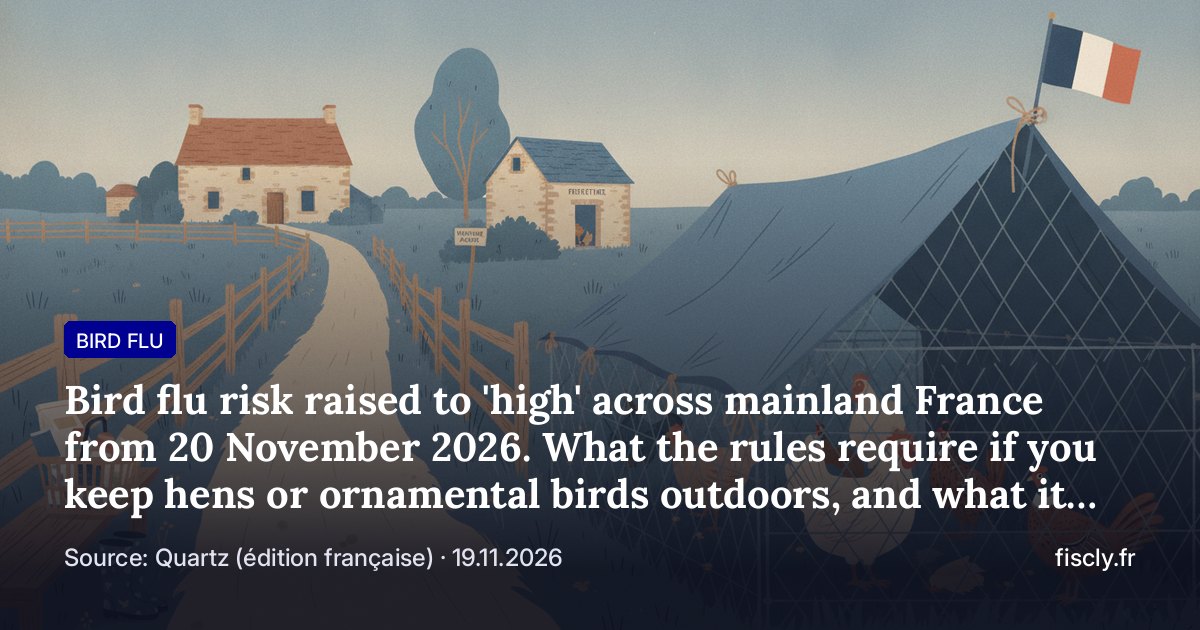
On 19 November 2026 the Journal officiel published an order (arrêté) from the agriculture ministry: from Friday 20 November, the risk level for highly pathogenic avian influenza (IAHP) across mainland France moves from "modéré" to "élevé". AFP reported the decision. According to the agency, the ministry cites rising cases in wild birds in several neighbouring countries and confirmed outbreaks in backyard flocks (basses-cours) in France.
What a "risk level" is, and why it is not only for farmers
France grades bird flu risk on three steps — "négligeable", "modéré" and "élevé". This is set out in Article 4 of the arrêté of 25 September 2023. The agriculture minister fixes the level by a separate order, and it determines compulsory measures for everyone who keeps birds, not just commercial farms. "Élevé" is the top step.
After the 2025–2026 winter epizootic, the level was cut to "négligeable" in early June. This season's outbreaks, according to AFP, have been found in the Gironde, Seine-Maritime and Landes. In Seine-Maritime, the prefecture says an outbreak was confirmed on 9 November in a backyard flock at Saint-Sauveur-d'Émmalleville, between Le Havre and Fécamp. A 3 km protection zone and a 10 km surveillance zone were set up around it; moving birds there without a DDPP exemption is prohibited.
Who is affected: the coop that comes with the house
Many newcomers meet these rules for the first time when they move into a house with a garden that already has hens, ducks or an aviary. Article 16 of the 2023 arrêté provides that at the "élevé" level, holdings with fewer than 50 poultry, and any place keeping ornamental or other captive birds (oiseaux captifs), must keep the birds shut in or protected by nets. Holdings of 50 birds or more fall under separate, stricter rules.
At this level, Article 18 also bans gatherings of poultry and captive birds — fairs, shows, competitions. There are exceptions for some cases: for example species listed in Annex I (including parrots, songbirds and pigeons) and birds kept permanently in a closed aviary with no contact with wild birds. Racing-pigeon competitions between 15 September and 10 April are banned at this level.
What applies at every level
The arrêté of 29 September 2021 (Article 15) already requires keepers of "non-commercial" birds — kept for eggs, for the table or for pleasure — to:
- protect feed and water from wild animals and birds;
- keep their birds away from birds on commercial holdings;
- control rodents and insects;
- contact a vet (vétérinaire habilité) if birds die abnormally;
- isolate dead birds until they are collected or shown to the vet.
Where a protection or surveillance zone has been declared nearby, local restrictions come on top. The list of communes and the measures are published by the departmental prefecture on its website.
And eggs or chicken from the shop?
The Seine-Maritime prefecture states plainly that eating poultry meat, foie gras, eggs and poultry products poses no risk to humans. Raising the level is a measure to protect poultry, not a ban on food.
What to do
- If you keep birds outdoors, from 20 November shut them in the coop or put up netting, and move feeders and drinkers out of reach of wild birds.
- Do not take birds to fairs or shows: at this level they are banned as a general rule.
- If birds start dying for no obvious reason, call a vet and do not throw the bodies away.
- Check your prefecture's website (
<département>.gouv.fr) for any nearby zones with extra restrictions.
The "élevé" level stays in force until the ministry lowers it by a new order. No end date has been announced.
Fiscly is an educational tool to help you understand the French tax system. It is not a substitute for professional tax advice. Tax situations are individual — always verify with impots.gouv.fr or a qualified accountant (expert-comptable) for your specific case.