Halloween falls on a protest day: the interior minister keeps marches out of city centres and warns about masks. When covering your face in public is allowed in France, and when it means a fine or a criminal charge
On 29 October Laurent Nuñez said that on Saturday 31 October protests will only be allowed outside city centres, with around 70,000 police and gendarmes deployed. What French rules say about covering your face — on an ordinary day, at a festivity and near a demonstration.
What happened
On Thursday 29 October, Interior Minister Laurent Nuñez held a press conference about Saturday 31 October — the third Saturday in a row of mass protests, and this time also Halloween. The minister described the risk of public disorder as very high and said around 70,000 police officers and gendarmes would again be deployed across the country, as they were the week before.
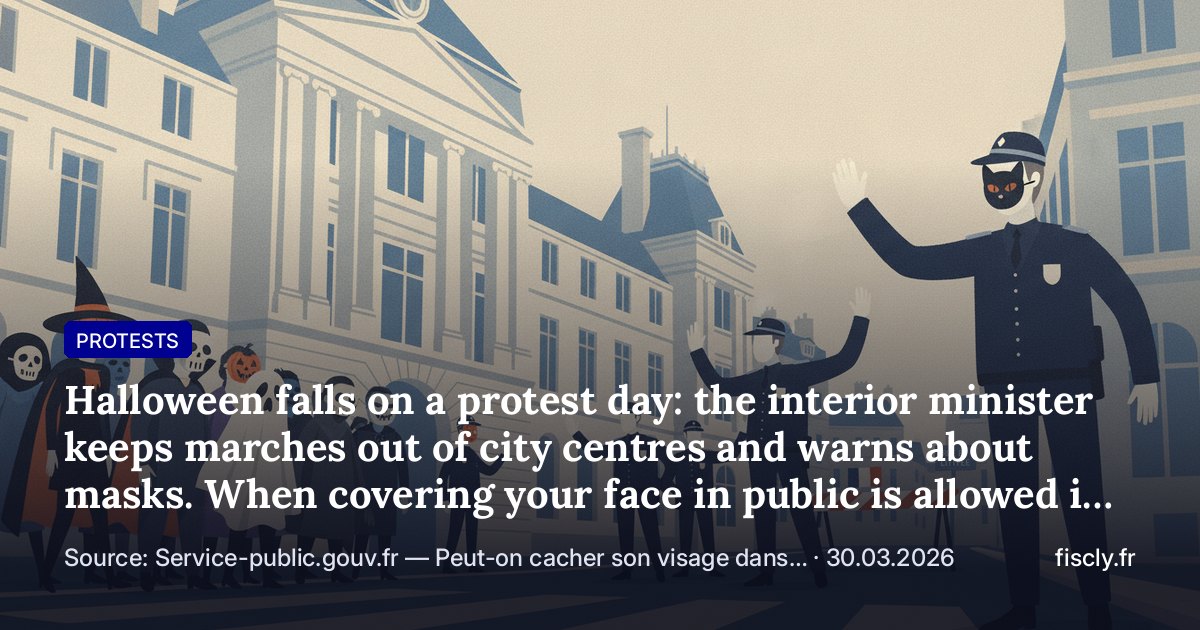
The main practical consequence: according to the minister, there will be no marches in city centres on Saturday. Prefects may authorise protests only on the outskirts, and only once organisers have given guarantees. Nuñez also pointed out that covering your face at a demonstration where disorder occurs or is expected is an offence, and he linked this explicitly to Halloween costumes.
This is a statement by the minister; the exact bans, zones and hours in each city are set by the local prefecture in an order (arrêté). These orders are published on the prefecture's website, often the day before or on the day itself.
A rule everyone should know: covering your face in public
It often surprises newcomers, but France has a general ban on covering your face in public space. It comes from Law No. 2010-1192 of 11 October 2010. Public space means streets and roads, plus places open to the public or used for a public service: shops, transport, public offices.
According to service-public.gouv.fr, the offence is wearing something that makes you impossible to identify. A scarf, a cap or sunglasses are fine if your face stays recognisable; a balaclava or a mask is not.
The law has exceptions. The ban does not apply when:
- the item is required or permitted by law or regulation (for example a motorbike helmet or a medical mask);
- it is justified by health or work reasons;
- it is part of a sport (for example a fencing mask);
- it is part of a festivity or an artistic or traditional event — service-public gives a carnival and a theatre performance as examples.
Whether a Halloween mask in the street counts as an exception is not spelled out on the official page; the law mentions "fêtes", and the guidance cites carnivals and stage shows.
What it costs
According to service-public.gouv.fr:
- the ordinary case — a €150 fine; a court may also order, or substitute, a citizenship course (stage de citoyenneté);
- deliberately covering your face at a demonstration to avoid being identified — up to €1,500, or up to €3,000 for a repeat offence;
- covering your face at a demonstration where disorder occurs or is expected — a criminal offence: up to one year in prison and a €15,000 fine. This is the rule the minister referred to.
A judicial police officer can check your identity and issue the fine. A security guard or municipal agent may ask you to remove the mask or leave, and call the police if you refuse. An ordinary member of the public cannot require you to remove it.
What this means in practice
- A party and a protest are different situations. A costume at a party and the same mask in a crowd near a protest are treated differently by the law — the difference runs from a fine to a criminal case.
- Carrying the mask is easier than wearing it if your route passes crowded spots or zones closed to protests.
- Children. If a teenager plans to go out in costume, it helps to agree beforehand on where and with whom, and to check the prefecture's site for any local restrictions on those nights.
- Where to look. Orders are on your department's prefecture website (an address like
<department>.gouv.fr; in Paris, the Préfecture de police), and the rules themselves are on service-public.gouv.fr, page "Peut-on cacher son visage dans un lieu public ?".
A little background
The general ban on covering your face has applied since April 2011. A separate, stricter criminal offence specific to demonstrations was added by a 2019 law. That is why ministers and police bring up masks on every protest day: for a resident, it is one of the few rules you can break simply by being in the wrong place in a carnival costume.
This is general information, not legal advice.
Fiscly is an educational tool to help you understand the French tax system. It is not a substitute for professional tax advice. Tax situations are individual — always verify with impots.gouv.fr or a qualified accountant (expert-comptable) for your specific case.