Storms in the Hérault overnight into 15 November: drivers stranded in floodwater near Montpellier, one woman airlifted. What car insurance covers if your car is flooded, and why everything hinges on the catnat 'arrêté'
On the night of 14–15 November, storms hit the eastern Hérault and dozens of cars were caught in floodwater. Based on service-public and justice.fr, here is when insurance pays for a flooded car, what an arrêté de catastrophe naturelle is, and which deadline you must not miss.
What happened
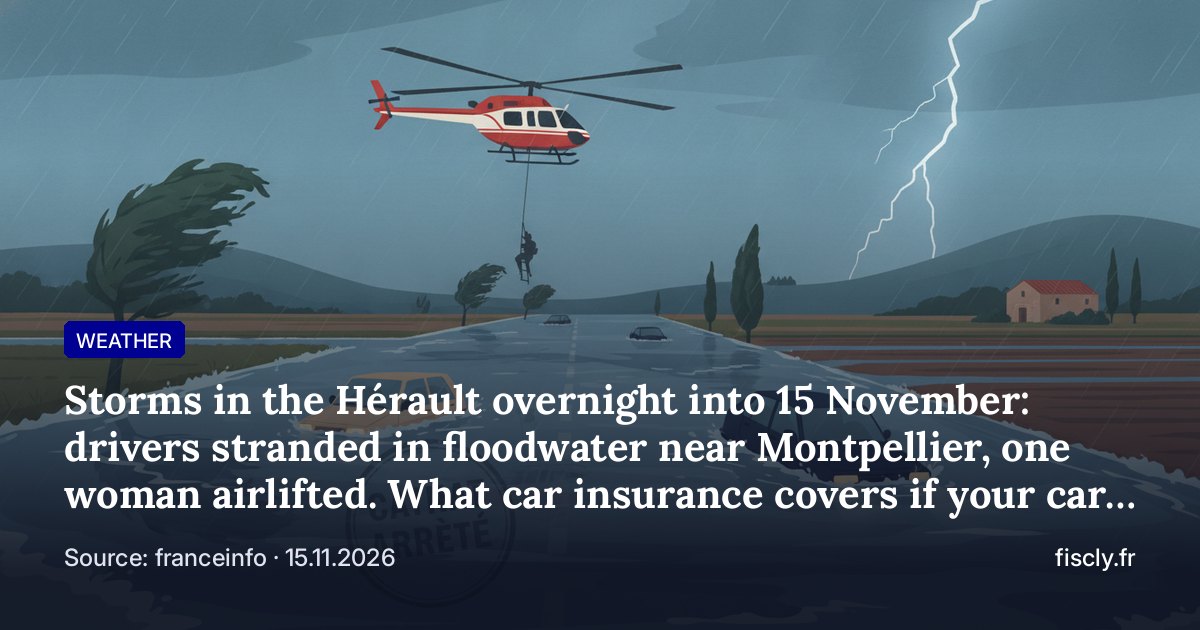
On the night of Saturday 14 to Sunday 15 November, violent storms crossed the Hérault. Météo-France had the Hérault, Gard and Bouches-du-Rhône on orange 'pluie-inondation' alert from Saturday evening to early Sunday morning (toutmontpellier.fr). The alert was lifted by Sunday morning.
South of Montpellier, dozens of drivers were stuck in their cars as the water rose. Some spent the whole night there until firefighters got them out. A 73-year-old resident's car was swept away by the water; at dawn she was winched into a Sécurité civile helicopter, and a friend says she is fine. On Sunday several roads around Montpellier were still closed (franceinfo). We did not find a consolidated list of closed roads in open official sources, so none is given here.
We have already written about why a car becomes a trap in a downpour. This post is about what comes next: your car has been in the water, and you need to know whether insurance will pay.
Compulsory insurance does not protect the car itself
Car insurance is compulsory in France, but the compulsory minimum is responsabilité civile: the driver's liability for damage caused to others. Protection for the vehicle itself, including against disasters, comes from optional cover. It can be bought item by item or bundled into a 'tous risques' (comprehensive) policy (justice.fr, updated 20 March 2026).
Service-public says the same from the disaster side: catastrophe naturelle cover is included only in some car policies, and a vehicle is covered when it is insured for damage (en dommages) (service-public.gouv.fr, F3076, checked 10 April 2026).
In practice, the first step is to open your contract and see what it includes beyond responsabilité civile, especially if the policy was taken out in a hurry when buying the car and you no longer remember what it contains.
The catnat arrêté: without it, the cover does not apply
A flood is not automatically a 'disaster' in the insurance sense. The state has to recognise it as one:
- recognition takes the form of an inter-ministerial arrêté published in the Journal officiel. It lists the communes, the period of the event and the type of damage;
- the request for recognition is made by the commune, not by residents. It has up to 24 months after the event to do so;
- without that arrêté, catastrophe naturelle cover does not apply (service-public F3076, checked 10 April 2026; justice.fr, updated 20 March 2026).
Some car policies also include separate tempête (storm) cover. According to justice.fr, it covers storms, hurricanes and cyclones when the event is not recognised as a natural disaster. Whether your contract includes it, and what counts as a storm, depends on the terms of the specific policy.
Deadlines and money
According to service-public (F3076, checked 10 April 2026):
- notify your insurer as soon as you know about the damage and no later than 30 days after the arrêté is published, by registered letter, preferably with acknowledgement of receipt;
- the excess (franchise) for catastrophe naturelle is set by law: €380 for homes and other property not used for business;
- the insurer pays an advance within 2 months and full compensation within 3 months. Your contract may set more favourable deadlines.
A common mistake is to wait for the arrêté, do nothing, and then miss the 30 days after it appears. The arrêté does not necessarily come out quickly, since the commune has up to 24 months to make its request. It is safer to notify the insurer straight away, then watch the Journal officiel and news from your town hall.
Towing and a replacement car
Some policies include assistance et dépannage cover: breakdown service, towing and a replacement vehicle after a breakdown, an accident and sometimes a theft (justice.fr). Whether it extends to weather damage depends on the contract. Ask your insurer before paying for a tow truck yourself.
Where to check
- catnat recognition for your commune: the Journal officiel on Légifrance and your town hall;
- what your own policy covers: the contract and the insurer's conditions générales;
- the general rules: service-public F3076 and justice.fr.
This describes the general rules and does not assess any individual case: what is covered is determined by the text of the contract.
Fiscly is an educational tool to help you understand the French tax system. It is not a substitute for professional tax advice. Tax situations are individual — always verify with impots.gouv.fr or a qualified accountant (expert-comptable) for your specific case.