France switches to winter time tonight: 3 a.m. becomes 2 a.m. How the clock change works and what to check
In the night of Saturday 24 to Sunday 25 October 2026, clocks in France go back one hour. Where the clock change comes from, why it was never scrapped, and what newcomers should check.
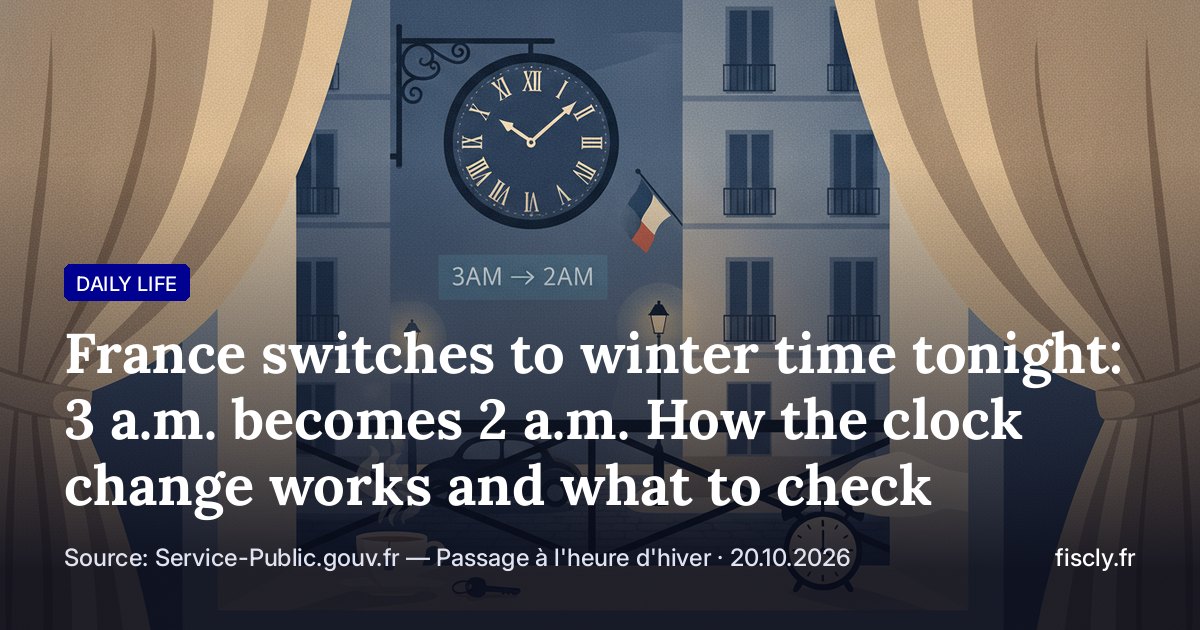
In the night of Saturday 24 to Sunday 25 October 2026, France switches to winter time. According to service-public.gouv.fr, clocks go back one hour: at 3 a.m. it will be 2 a.m. The night is an hour longer, mornings get lighter and evenings get dark earlier.
How it works
The clock change in France is not a national quirk but a common European rule. As service-public points out, the dates have been harmonised across the EU since 1998:
- winter time starts on the last Sunday of October;
- summer time starts on the last Sunday of March.
That is why the date moves from year to year. In 2026 the last Sunday of October falls on the 25th. Under the same rule, the next change — to summer time, with clocks going forward — falls on the last Sunday of March 2027, which is 28 March.
A little history
Service-public notes that France introduced the seasonal clock change after the 1973–1974 oil shock. The idea of fitting clock time to daylight is older, but the current system dates from then.
Wasn't the clock change abolished?
No. In March 2019 the European Parliament voted to end seasonal clock changes, with the plan to apply this from 2021. The decision was then postponed — partly because of the Covid-19 pandemic, according to service-public — and the text is no longer on the agenda. So the rule still applies, and clocks still change twice a year.
What to check this evening
There is no formality to complete: you just change the time. But newcomers tend to hit a few typical snags.
- Clocks that don't change themselves. Phones and computers that take their time from the network usually adjust automatically. Oven and microwave clocks, car clocks, mechanical alarm clocks, heating and water-heater timers do not.
- Night travel and night shifts. The hour between 2 a.m. and 3 a.m. happens twice tonight. If you have a night shift, a night train, an early flight or a transfer, check the time on the ticket and with your employer: "2:30" occurs twice this night.
- Calls with family and colleagues abroad. The time difference with a country that does not change its clocks, or changes them on another date, may shift by an hour for a while. Check your call and online-meeting schedule for the coming weeks.
- Appointments. A Monday appointment at the prefecture, the doctor or the bank is set in local time and does not move — your alarm just needs to be on the new time.
- Children. The change falls during the Toussaint school holidays: in zones A, B, C and Corsica they began on 17 October and classes resume on Monday 2 November (service-public). Families have a week for children to adjust before school.
The bottom line
The clock change in France is a yearly routine under a European rule: last Sunday of October — back one hour; last Sunday of March — forward one hour. Abolition was discussed but never happened. Tonight, 3 a.m. becomes 2 a.m.
Source: service-public.gouv.fr, "Passage à l'heure d'hiver", updated 20 October 2026; school holiday dates — service-public.gouv.fr, "Les dates des vacances de la Toussaint 2026", published 31 July 2026.
Fiscly is an educational tool to help you understand the French tax system. It is not a substitute for professional tax advice. Tax situations are individual — always verify with impots.gouv.fr or a qualified accountant (expert-comptable) for your specific case.