Protests on 14 November: about 106,000 marchers by the interior ministry's count, 219 arrests, next date 21 November. Who pays in France if your car or property is damaged on a protest day
The tally from a fifth Saturday of cost-of-living protests, and the practical side: insurance, a police complaint, the FGTI fund via the CIVI commission, and the State's liability for damage caused by crowds.
What happened
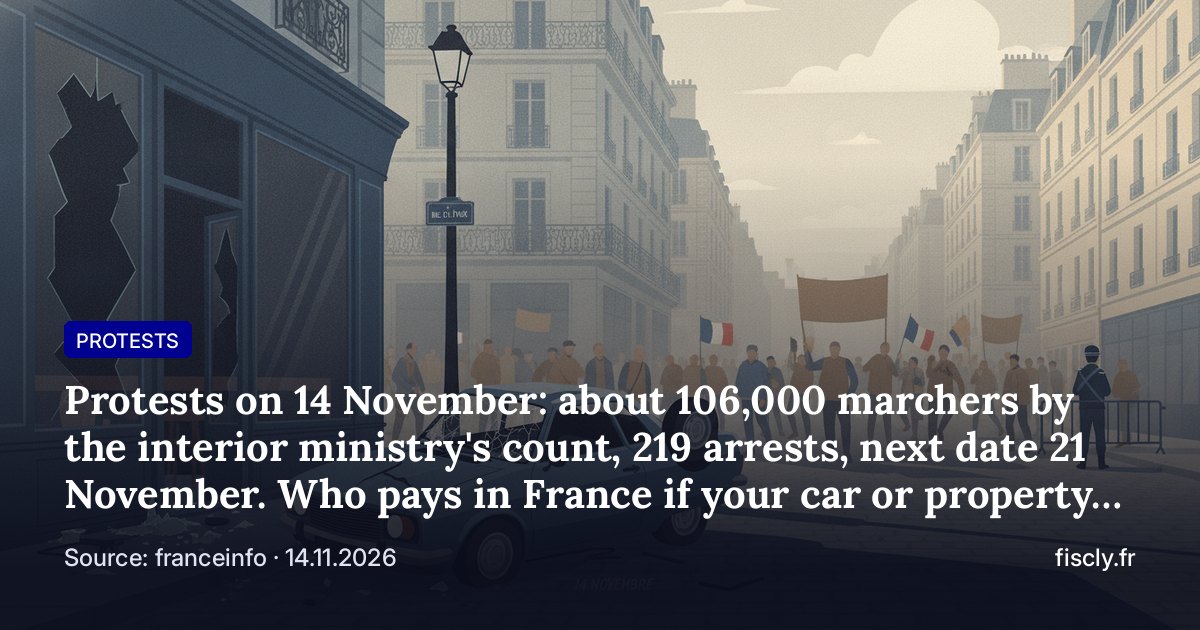
On Saturday 14 November, France saw a fifth Saturday in a row of protests against the cost of living (vie chère). The interior ministry put turnout at about 106,000 nationwide, 24,000 of them in Paris. The organisers, a coalition of youth organisations, gave 200,000 nationwide and 100,000 in Paris. A week earlier the ministry had counted 146,000, so by the official count turnout fell.
By 6 pm, 219 people had been arrested nationwide and ten police officers had minor injuries. Incidents were reported in Marseille, Grenoble, Lyon, Bordeaux, Poitiers and Montpellier. The ministry described the overall situation as under control. The Paris prefecture said the march reached Place de la Nation and most people left calmly.
The movement is not over. The same day, a member of the gilets jaunes coordination announced another nationwide Saturday on 21 November. No location or programme has been given yet.
If your property is damaged on a protest day
Every weekend someone wakes up to a smashed shop window, a broken car window or a burnt-out car. Newcomers often don't know that France has several ways to get compensation, and that they can be used side by side.
1. A police complaint. Service-public's page on vandalism (vandalisme) lists a victim's options: file a complaint (online if the offender is unknown), claim damages, join the criminal case as a civil party, apply to the CIVI commission, or claim from your home insurer. The complaint is the basis for every other step.
2. Insurance. Whether it pays depends on your contract and the cover you chose. Check before the next Saturday, not after it.
3. The FGTI fund via the CIVI. If insurance doesn't pay, the rules allow a claim to the Commission d'indemnisation des victimes d'infractions at the court for your home address. The FGTI guarantee fund makes the payment. According to service-public (page verified 14 August 2026):
- a burnt car (deliberate arson in France): the car's roadworthiness test (contrôle technique) and insurance must have been valid at the time, you must not already have been compensated by another body, and income must not exceed €29,149.50 for a single person. The payment is capped at €4,857;
- other property damage (theft, damage, destruction): in addition, you must be in a "serious material or psychological situation", and income must be below €19,433 for a single person. The same €4,857 cap applies;
- deadline: 3 years from the events if there was no trial, or 1 year after the final criminal ruling;
- if the CIVI cannot help, you can turn to the recovery assistance service SARVI.
The page sets no nationality condition for offences committed in France.
4. The State's liability. Article L. 211-10 of the Internal Security Code makes the State civilly liable for damage caused by crimes committed "by open force or violence" by crowds (attroupements or rassemblements), armed or not, against people or property. The article has limits, though. In 2023 the Conseil d'État (decision no. 465591) rejected a claim by SNCF Réseau over barricades set on fire on a high-speed line. It found that the acts were carried out by a pre-organised group that had broken away from a social movement for that purpose, and such a group is not a "crowd" under the law. Claims of this kind go to the administrative courts, and a court decides whether a given case qualifies.
A short plan for next Saturday
- If you live or park near a march route, move your car in advance.
- Check what your home and car insurance actually cover.
- If something is damaged: photograph it, file a complaint, tell your insurer and keep the paperwork. Neither the CIVI nor a court can help without it.
- Victim support: 116 006, and the FGTI on +33 1 43 98 77 00 (both listed on the service-public page).
Fiscly is an educational tool to help you understand the French tax system. It is not a substitute for professional tax advice. Tax situations are individual — always verify with impots.gouv.fr or a qualified accountant (expert-comptable) for your specific case.