Protests on 21 November 2026, a sixth weekend in a row: what police 'sommations' are, how a dispersal order is announced, and what staying put can cost
France sees another day of cost-of-living protests on 21 November 2026. Using the text of the law: how the warnings before force is used are worded, who gives them, and what the Code pénal provides for people who do not leave.
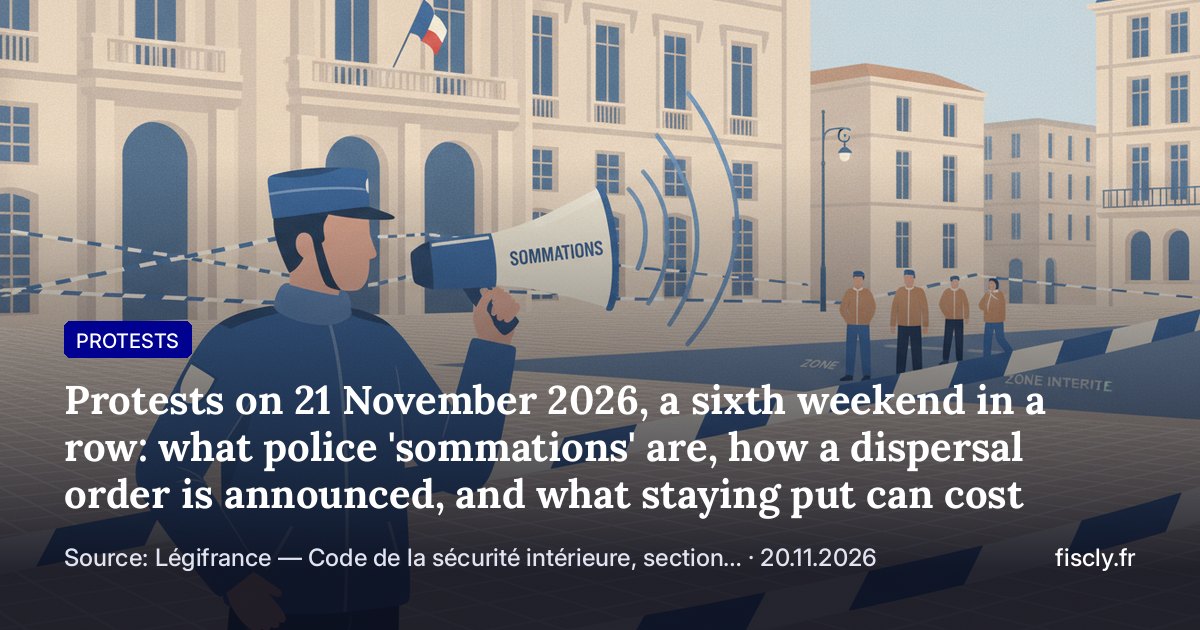
On Saturday 21 November people are out on the streets of France again, for the sixth weekend running. According to franceinfo, in Paris the Île-de-France union alliance (CGT, CFDT, FO, FSU, Solidaires), together with student and lycée organisations, is marching against the high cost of living from Place de la République to Place de la Nation, setting off at 14:00. The gilets jaunes coordination has also called actions, with the date falling on the movement's eighth anniversary. Interior Minister Laurent Nuñez said about 70,000 police officers and gendarmes would be deployed nationwide, the same as on previous Saturdays.
Restrictions known so far
- Paris. The RATP is closing 16 metro stations at the request of the police prefecture: some from opening time (including Concorde, Charles de Gaulle – Étoile and Franklin D. Roosevelt), some from 11:00 along the eastern route (Oberkampf, Voltaire, Charonne and others), and Châtelet and Les Halles from midday. From 12:00, sections of lines 6 and 11 are interrupted. The list can change during the day: check the Bonjour RATP app.
- Bouches-du-Rhône. France 3 reports that the prefecture has banned undeclared protests from 19:00 on Friday 20 November until 05:00 on Monday 23 November. One declared march is allowed in Marseille (gathering at 14:30 at the Réformés), and a rally in Aix-en-Provence has been banned.
For how the day unfolds, follow the RATP, your department's prefecture website and the news. What follows will still be useful after 21 November.
A march and an 'attroupement' are not the same thing
A declared, peaceful march is a demonstration. But the law has a separate notion: the attroupement. Article 431-3 of the Code pénal defines it as any gathering of people on the public highway or in a public place that is likely to disturb public order. Police may break up an attroupement, but only after two warnings to disperse have gone unheeded — the 'sommations'.
In practice, even if you came to a lawful protest or were just passing by, the crowd around you can at some point become an attroupement, and the rules then change for everyone who stays.
What the warnings sound like
The procedure is set out in Article R211-11 of the Code de la sécurité intérieure (as amended by decree no. 2021-556 of 5 May 2021). Three messages are given by loudspeaker:
- Announcement of presence. It opens with 'Attention ! Attention !' and tells listeners they are taking part in an attroupement and must disperse.
- First warning: 'Première sommation : nous allons faire usage de la force. Quittez immédiatement les lieux' — 'force will be used, leave immediately'.
- Final warning: 'Dernière sommation…' with the same wording.
If a loudspeaker cannot be used or is clearly ineffective, each message may be replaced or supplemented by a red flare (fusée rouge). If weapons from the list in Article R211-16 — chiefly grenades, including tear gas — are to be used to disperse the crowd, the final warning is repeated.
Who gives them: under Article R211-12, the prefect or a member of the prefectoral corps, the mayor or a deputy mayor, or a judicial police officer (OPJ) of the national police or gendarmerie. They must wear a tricolour sash or tricolour armband. The decision to use force after the warnings rests with one of the officials listed in Article R211-21, who must be present on the spot. Under Article R211-13, force is allowed only where absolutely necessary, must be proportionate, and stops once the disturbance has ended.
What staying can cost
Code pénal (current version):
- Art. 431-4: an unarmed person who voluntarily keeps taking part in an attroupement after the warnings faces one year in prison and a €15,000 fine; deliberately hiding one's face to avoid identification raises this to three years and €45,000;
- Art. 431-5: taking part in an attroupement while armed carries up to three years and €45,000, and an armed person who stays after the warnings faces up to five years and €75,000;
- Art. 431-10: taking part in a demonstration while carrying a weapon is in itself punishable by up to three years and €45,000.
The key word in Article 431-4 is 'volontairement': the law targets people who stay of their own accord.
What this means in practice
- If you hear 'Attention ! Attention !' or see a red flare, that is your cue to leave, not to find out what is going on. The warning itself requires you to leave immediately.
- A person wearing a tricolour sash or armband near a police line is, under the rules, the one who gives the warnings.
- A scarf, hood or mask covering your face after the warnings turns the same offence into a more serious one (second paragraph of Article 431-4).
- For a foreign resident holding a residence permit, any criminal proceedings are a reason to consult an avocat rather than handle things alone.
At the time of writing, no further protest date after 21 November had been announced.
Fiscly is an educational tool to help you understand the French tax system. It is not a substitute for professional tax advice. Tax situations are individual — always verify with impots.gouv.fr or a qualified accountant (expert-comptable) for your specific case.