Protests across France on 17 October: what foreign residents should know about papers, police checks and banned marches
On Saturday, protests against the cost of living took place across France: motorways blocked, petrol stations occupied, hundreds of arrests. What documents a foreign resident is expected to carry, how identity checks work, and the difference between an undeclared and a banned demonstration.
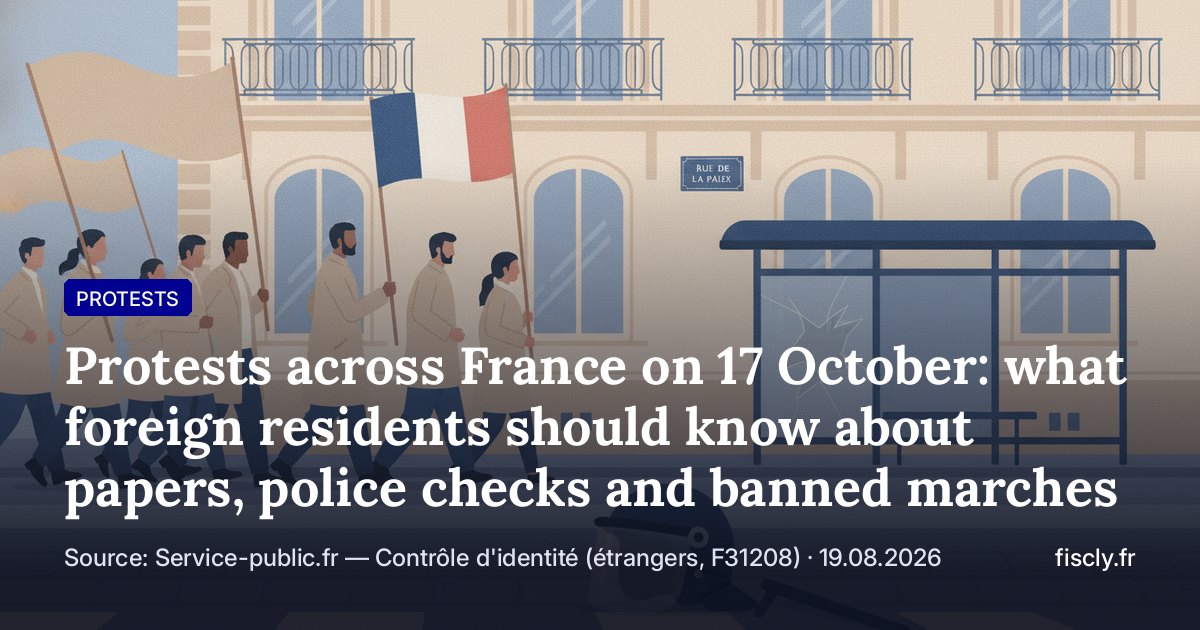
On Saturday 17 October, France held a nationwide day of action against the high cost of living. The call first spread on social media in early September and was backed by yellow-vest collectives, the CGT and Solidaires unions, and student and lycée organisations (Euronews).
What happened
According to the round-up by franceinfo (updated on the evening of 17 October):
- marches took place in many cities; prefecture estimates put Toulouse at around 32,000 people and Montpellier at 12,000 to 17,000;
- the Interior Ministry counted 272 arrests nationwide by 3 pm; in Paris, prosecutors reported 195 by 4 pm, 13 of them minors. These are interim figures: the Ministry had published no national total by the evening, and the Paris count had already risen after 3 pm — so the national figure for the day is higher than 272;
- roads were blocked: the A10 motorway near Tours (cleared at around 12:45), the RN10 around Angoulême, the A480 near Grenoble and the Chambéry ring road; Marseille Saint-Charles station was closed as a safety measure;
- petrol stations were blocked in Tours and Grenoble;
- several cities saw clashes, and in some places protesters got into town hall buildings.
In Paris, the police prefecture had already turned down the declared routes of two marches before Saturday and proposed alternatives. No further protest dates had been reported at the time of writing.
For most newcomers, a day like this is less about politics than about logistics and paperwork: a closed motorway, a closed station, a check in the street. Below are the rules that apply on any protest day, not just 17 October.
Papers: what to carry
According to service-public, an adult foreign national can be asked to show a residence document even outside an identity check. Such a check may only take place in the street or in places open to the public, cannot be systematic, and cannot last more than 6 hours in a row at the same spot. It must be based on signs external to the person themselves, for example a car with foreign plates.
Which documents count:
- stays of up to 90 days: a passport with a valid visa (where that nationality needs one);
- more than three months: one of a long-stay visa, carte de séjour temporaire, carte pluriannuelle, carte de résident, a card marked 'retraité', a récépissé for a first card, renewal or duplicate, an attestation de demande d'asile, or an autorisation provisoire de séjour.
Without a document on hand, the person can be taken to a police or gendarmerie station and held there while their right of residence is checked. A foreign minor is not subject to this check.
A common mistake is leaving the récépissé at home while a card is being renewed: the rules list it explicitly as a valid document.
Identity checks
According to service-public, an identity check is possible, among other cases, to prevent a breach of public order when there is a 'serious and current' risk at that place and time. Identity can be proved by any means; documents with a photo carry more weight. Officers are not obliged to accept the digital ID from the France Identité app during a check.
If identity cannot be established, a vérification d'identité follows: the person can be held on the spot or at a station for no more than 4 hours from the start of the check. They can ask for the prosecutor and a person of their choice to be informed, and receive a copy of the report at the end. A check that seems unlawful or discriminatory can be challenged with the Défenseur des droits, the IGPN (police) or IGGN (gendarmerie), or by filing a plainte.
Declared, undeclared and banned demonstrations
According to service-public:
- the organiser files a declaration with the town hall or prefecture no more than 15 and no less than 3 'clear days' ahead; in Paris, at least one month ahead;
- if a march threatens public order, the mayor or prefect bans it by decree (arrêté); in Paris, the police prefect does so;
- the prefect can also ban carrying objects that could be used as weapons, from 24 hours before the event until it disperses;
- organising an undeclared or banned demonstration is punishable by up to 6 months in prison and a fine of up to €7,500.
For participants, the key point is different: the offence is taking part in a demonstration banned under Article L. 211-4 of the Internal Security Code. Article R. 644-4 of the Penal Code makes this a fourth-class contravention, as quoted by the Conseil d'État. So on a protest day it is worth knowing not only the route, but whether the march has been banned.
What follows from this
- Given the rules on document checks, it makes sense on protest days to carry a passport and a valid residence document or récépissé.
- Before travelling by motorway or train on such a day, check your carrier's information and road conditions.
- If actions at petrol stations have been announced, it is sensible to fill up in advance.
- A disputed check is a matter for the Défenseur des droits.
This is general information, not legal advice.
Fiscly is an educational tool to help you understand the French tax system. It is not a substitute for professional tax advice. Tax situations are individual — always verify with impots.gouv.fr or a qualified accountant (expert-comptable) for your specific case.