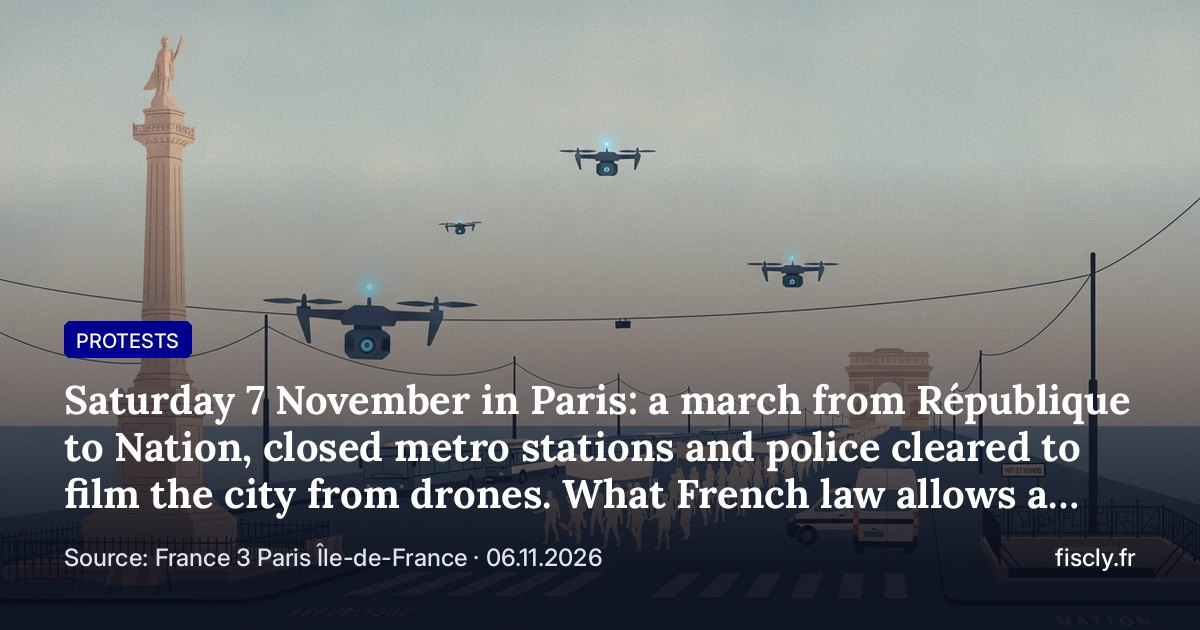
Saturday 7 November in Paris: a march from République to Nation, closed metro stations and police cleared to film the city from drones. What French law allows a police camera in the sky, and what it doesn't
Another day of protests in Paris: several stations shut from the morning, gatherings banned around Gare du Nord and Gare de Lyon, and aerial filming authorised. How police drones work in France: who authorises them, what they may not do, how long footage is kept and what rights a person on camera has.
What we know on Saturday morning
On Saturday 7 November, the unions (CGT, FO, FSU, Solidaires, CFDT), joined by student and school-pupil organisations, are marching again. In Paris the march sets off at 14:00 from place de la République towards place de la Nation, the same route as on Thursday 5 November. According to France 3 Paris Île-de-France, RATP is closing stations at the request of the Préfecture de police, in two waves:
- from 05:30: Charles de Gaulle Étoile (including RER A), Argentine, George V, Franklin D. Roosevelt, Champs-Élysées Clemenceau, Concorde, Tuileries and Miromesnil; line 6 does not run between Kléber and Étoile;
- from 10:00: Châtelet, Les Halles, Oberkampf, Richard Lenoir, Saint-Ambroise, Voltaire, Charonne and Rue des Boulets; line 11 does not run between Châtelet and Hôtel de Ville.
The préfecture decides when the stations reopen. It has also banned a 'gilets jaunes' gathering on place de la Concorde, and gatherings around Gare du Nord and Gare de Lyon from 08:00 to 23:30. Interior Minister Laurent Nuñez said 70,000 police and gendarmes would again be deployed nationwide. One more detail that is easy to miss: by order no. 2026-01547, the préfecture authorised filming and transmitting images from cameras on aircraft, meaning drones, in Paris on Saturday. How many devices and over which streets is not stated in the material available to us.
If you have a train from Gare du Nord or Gare de Lyon on Saturday, allow extra time: stations and connections can close and reopen during the day. Check the RATP app or website for the current situation.
The police drone: what it rests on
The rules sit in the chapter of the Code de la sécurité intérieure on cameras installed on aircraft (articles L242-1 to L242-5; the last was amended by a law of 18 August 2026 and, in its current wording, applies until 1 January 2029). Police and gendarmerie can be authorised to film from the air for a list of purposes, including the security of gatherings of people on the public highway where serious public-order disturbances are possible. The law's condition is that the filming must be proportionate to its purpose.
Who authorises it. The préfet of the département, or in Paris the préfet de police, by a written, reasoned decision. It sets the purpose, the maximum number of cameras recording at the same time, and a geographic perimeter no wider than strictly necessary. For a demonstration, the authorisation lasts only for the gathering itself. In an emergency it can be given by any means, but it must be put in writing within one hour.
What a drone may not do.
- record sound;
- use automated facial recognition;
- be automatically linked or cross-matched with other personal-data systems;
- deliberately film the inside of homes or their entrances. If such images are captured, recording stops; if it could not be stopped, the images are deleted within 48 hours of the end of the deployment, unless they are passed to the prosecutor.
Continuous filming is not allowed either: the law requires use to be strictly necessary for the specific operation and suited to its circumstances.
How long footage is kept. No more than seven days from the end of the deployment. During that time no one may access the recordings, except to report an offence to the prosecutor. Recordings needed for judicial, administrative or disciplinary proceedings are exempt from the seven-day limit. Extracts used for police training are anonymised.
What rights a person on camera has
- Information. The public must be told about the filming and who is responsible for it 'by any appropriate means', unless circumstances prevent it or it would defeat the purpose of the operation.
- No right to object. The right to object to processing does not apply to these recordings; article R242-13 says so explicitly.
- Access, rectification, erasure. These rights are exercised with the data controller, but they can be restricted. Where they are restricted, the person goes through the CNIL.
The rules are the same for everyone in the filmed area: the texts we read make no distinction by nationality or residence status.
What this means in practice
The law is designed for watching crowds: no sound, no facial recognition, short retention. But within those seven days a recording can become evidence if an offence is reported to the prosecutor, and once proceedings have started it is kept longer. If you are not taking part, the simplest course is to stay away from the République–Nation route in the afternoon and check in advance whether your station is open. Our source says nothing about protest dates after Saturday.
This post is for information only and is not legal advice.
Fiscly is an educational tool to help you understand the French tax system. It is not a substitute for professional tax advice. Tax situations are individual — always verify with impots.gouv.fr or a qualified accountant (expert-comptable) for your specific case.