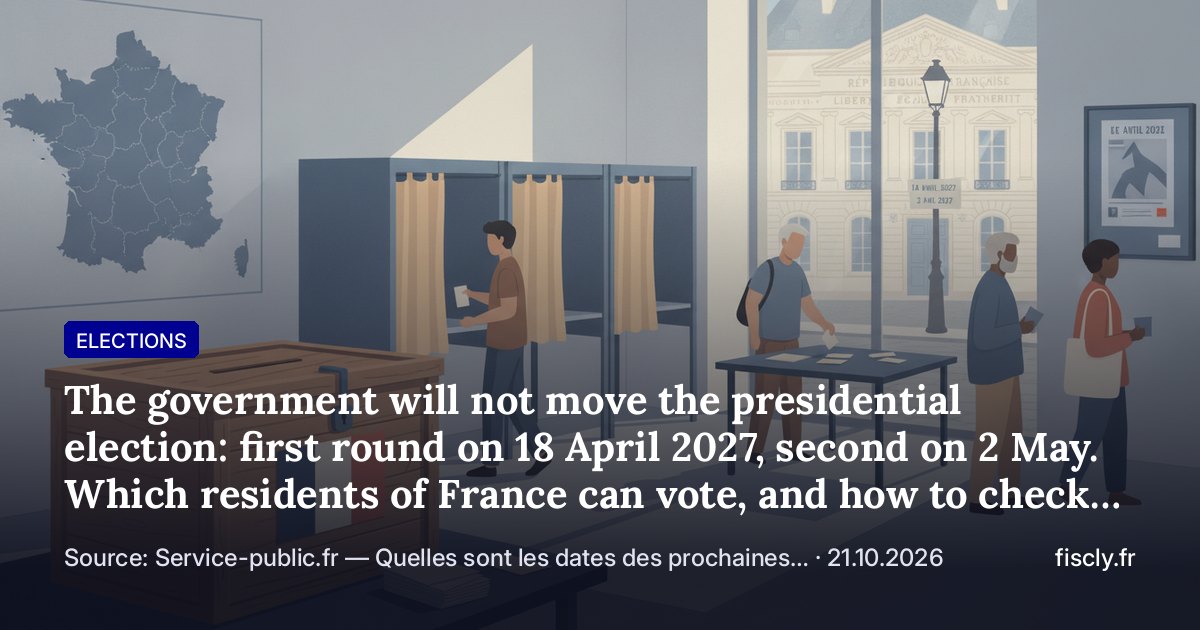
The government will not move the presidential election: first round on 18 April 2027, second on 2 May. Which residents of France can vote, and how to check the electoral roll
On 28 October the government refused to change the dates of the presidential election. Only French citizens vote; people who became French from 2019 onwards are registered automatically, but it is worth checking early. EU citizens vote only in municipal and European elections.
What happened
On 28 October 2026, after the Council of Ministers, government spokesperson Maud Bregeon said the dates of the presidential election will not change. Bruno Retailleau, leader of Les Républicains, had asked for them to be moved because the second round falls the day after the 1 May marches. The government said no (as reported by franceinfo).
The dates themselves are not new: the Council of Ministers set them on 1 July 2026. According to service-public:
- first round on Sunday 18 April 2027, second round on Sunday 2 May 2027;
- because of the time difference, Guadeloupe, French Guiana, Martinique, French Polynesia, Saint-Barthélemy, Saint-Martin and Saint-Pierre-et-Miquelon vote on the Saturdays, 17 April and 1 May; La Réunion, Mayotte, New Caledonia and Wallis-et-Futuna vote on the same days as mainland France;
- voters are formally convened at least 10 weeks before the first round.
The 28 October statement is the government's word, not a new document. The rules and dates remain those announced in July. The decree convening voters has not been issued yet.
Who votes in the presidential election
Article 3 of the Constitution defines voters as adult French nationals who enjoy their civil and political rights. A residence permit, including the ten-year carte de résident, does not give a vote, however many years someone has lived in France.
The Constitution makes one exception for foreigners: EU citizens living in France may vote in municipal elections (article 88-3). Service-public adds European Parliament elections. In practice:
- an EU citizen votes in municipal elections (next in 2032) and European elections (2029), provided they have registered on the supplementary rolls, the listes électorales complémentaires. They do not vote in presidential or legislative elections, and the supplementary registration does not extend to them;
- citizens of other countries have no right to vote in French elections under the Constitution.
For people who have become French
Under the rules described on service-public, a person who became French from 2019 onwards is added to the electoral roll automatically. No separate application is needed for that.
To confirm the registration exists and which polling station it points to, there is the online service "Vérifier votre inscription électorale et votre bureau de vote" on service-public. It takes a couple of minutes, and now is a better time than the spring.
If there is no registration, an application can be made online (with scans of an identity document and a justificatif de domicile less than three months old), by post or at the town hall. Registration is open all year, but each election has a cut-off. For postal applications, service-public puts it this way: the town hall must receive the letter no later than the sixth Friday before the first round. The page does not yet give the exact date for 2027.
The voter card is sent no later than three days before the first round. If it has not arrived, it is kept at the polling station and handed over on election day against proof of identity.
Common mistakes
- Assuming long residence or a carte de résident gives a vote. It does not: only French citizens vote for president.
- An EU citizen assuming municipal registration covers the presidential election. The supplementary rolls are for municipal and European elections only.
- Leaving the check to the last weeks. The application cut-off falls six weeks before the first round, while the online check is available all year.
What comes next
The dates will be formally fixed by the decree convening voters, issued at least 10 weeks before the first round. For now the government says it has no intention of changing 18 April and 2 May. Any change would appear on the service-public page "Quelles sont les dates des prochaines élections ?".
Fiscly is an educational tool to help you understand the French tax system. It is not a substitute for professional tax advice. Tax situations are individual — always verify with impots.gouv.fr or a qualified accountant (expert-comptable) for your specific case.