All of Brittany is still at the top drought level, 'crise', in November. What France's four levels of water restrictions mean, what residents may not do, and how to check your address on VigiEau
As of 3 November, Côtes-d'Armor, Finistère, Ille-et-Vilaine and Morbihan are at 'crise' level. How water restrictions work in France, who they apply to, the fine, and where to see the rules for your address.
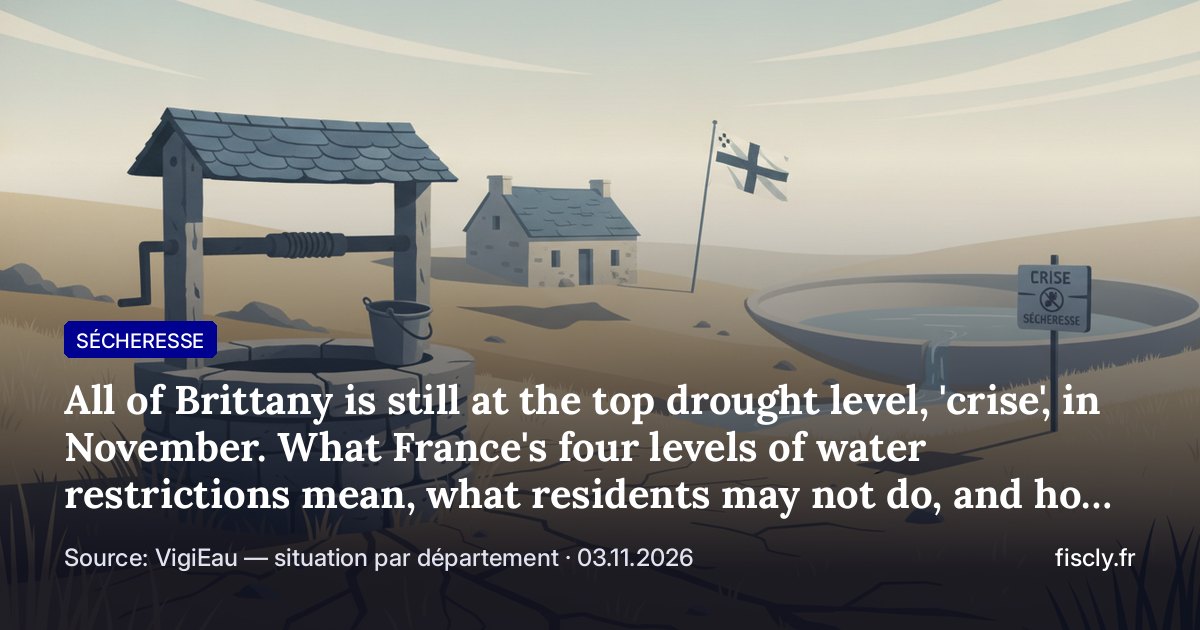
As of 3 November, all four departments of Brittany — Côtes-d'Armor, Finistère, Ille-et-Vilaine and Morbihan — are at 'crise', the highest level on the scale of water restrictions. That is what the government service VigiEau shows. The watering season is long over, but the restrictions remain.
What we know
- In Ille-et-Vilaine, a prefectoral order of 14 August put both drinking water and the aquatic environment (milieux aquatiques) at crise level. That order was amended on 20 October; the amendment is listed on the prefecture's website.
- France 3 Bretagne reported on 3 November that around three quarters of the region's drinking water comes from rivers rather than groundwater, so a long shortage of rain reaches the taps quickly. The Drennec reservoir, Finistère's strategic reserve, is about one third full, according to the outlet.
- The same outlet reports that 35 communes in northern Ille-et-Vilaine, between the Bay of Mont-Saint-Michel and the Rance valley, are preparing for possible rationing of the supply if consumption is not cut by half. This is contingency planning, not an announced cut.
The four levels: how the system works
Restrictions are set by the prefect of each department. First comes a framework order (arrêté-cadre) that defines the levels, the thresholds and the measures in advance. When a threshold is reached, a temporary restriction order is issued. A mayor can use their own powers to impose stricter measures in their commune. Restrictions must be proportionate and time-limited, and are lifted once the cause has gone.
- Vigilance — a call to save water, no bans.
- Alerte — first restrictions: watering, filling and emptying pools, washing cars, irrigating crops.
- Alerte renforcée — the same restrictions, tightened.
- Crise — only priority uses are allowed: health, drinking water, civil security, sanitation. Many household uses of water are banned.
What it means for residents
Take Ille-et-Vilaine, in the 14 August version as described by Rennes Métropole. Banned: watering lawns, flower beds and shrubs, including in pots (collected rainwater is allowed; vegetable plots from 8 pm to 8 am); washing a car or boat, including at a car wash; filling a private pool larger than 1 m³; cleaning façades, terraces, walls and roofs. Other departments have their own lists, and the October changes in Ille-et-Vilaine are worth checking on VigiEau.
Common mistakes newcomers make:
- 'I rent a flat, this doesn't concern me.' Restrictions apply to all water users, private individuals included. In Ille-et-Vilaine the washing ban covered car washes too.
- 'Summer is over, so the bans are too.' The level stays in place until the prefect lifts it.
- Going by regional news. The measures depend on your address and on where the water comes from: mains, river or well.
The fine for a private individual who breaks the rules can reach €1,500, and €3,000 for a repeat offence.
What to do
- Enter your address on vigieau.gouv.fr or find yourself on the map: the service shows which measures apply. You can also subscribe to email updates there.
- Orders are also published on your department's prefecture website, and town halls post them up.
- Rennes Métropole advises cutting daily use, for example with shorter showers, and reporting visible leaks in the street. VigiEau adds household tips: a water-saving shower head, tap aerators, rainwater for the garden.
What next
France 3, citing Météo-France, mentions light showers on 3 November in the north of the region, then on 6–7 November and from 10 to 12 November over most of Brittany; how heavy they will be is not known. No date has been announced for lifting the crise level.
This article is for general information; the current measures for a specific address are published by the prefecture and on VigiEau.
Fiscly is an educational tool to help you understand the French tax system. It is not a substitute for professional tax advice. Tax situations are individual — always verify with impots.gouv.fr or a qualified accountant (expert-comptable) for your specific case.