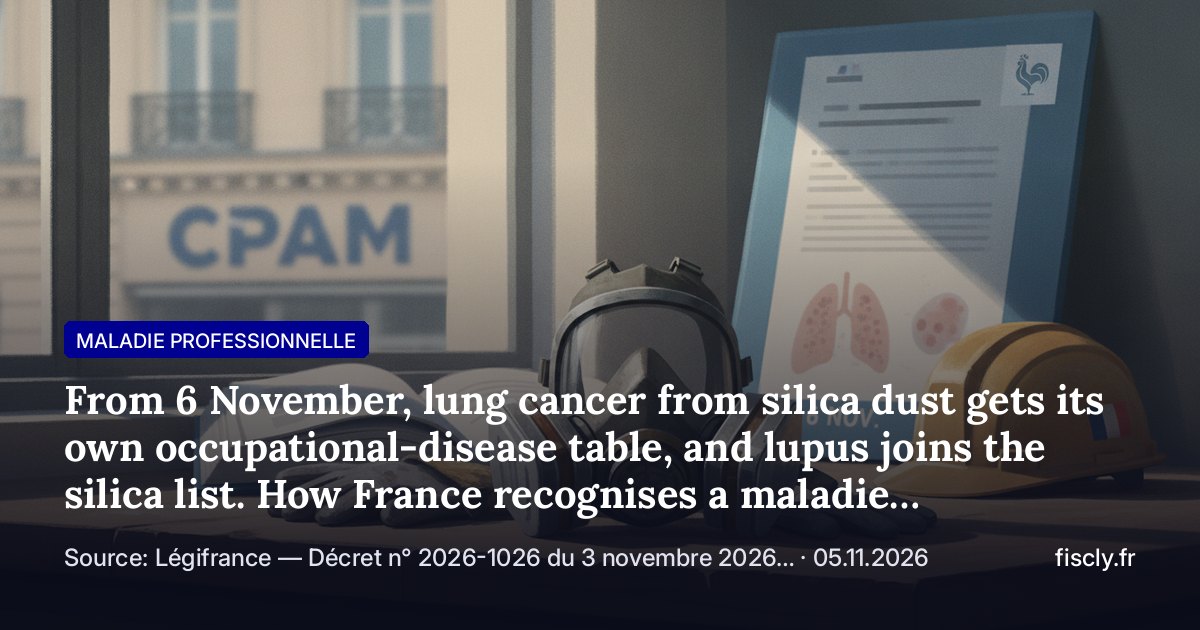
From 6 November, lung cancer from silica dust gets its own occupational-disease table, and lupus joins the silica list. How France recognises a maladie professionnelle, the filing deadlines, and what recognition brings
A decree published in the Journal officiel on 5 November creates table 25 ter (lung cancer from crystalline silica dust) and extends table 25. Which jobs it covers, how to declare an occupational disease to the CPAM, and the deadlines for people who are already ill.
What happened
On 5 November 2026 the Journal officiel published decree no. 2026-1026 of 3 November 2026, which revises and extends the occupational-disease tables of the régime général. According to the summary on Legifrance, it takes effect the day after publication, i.e. on 6 November.
There are two changes:
- A new table no. 25 ter: primary bronchopulmonary cancer (cancer broncho-pulmonaire primitif) caused by inhaling crystalline silica dust (silice cristalline). The prise en charge period is 40 years, subject to at least 10 years of exposure. The decree's summary says the table applies regardless of whether the person has silicosis.
- Table no. 25 is extended: systemic lupus erythematosus (lupus érythémateux systémique) is added to line A3, after progressive systemic sclerosis. The word 'minérales' is removed from the table's title.
Which jobs are covered
The list of work in table 25 ter is closed (liste limitative). It includes, among others:
- drilling, extracting and transporting ores and rocks containing silica; digging galleries and mine shafts;
- crushing, grinding and sieving rock; cutting and polishing stone; sanding and sawing materials containing silica;
- quarrying and working slate;
- making abrasives, glass, porcelain, earthenware, other ceramics and refractory products;
- foundry work (shake-out, fettling, sand removal), grinding with silica wheels, sandblasting;
- construction, maintenance and demolition work that involves breathing such dust;
- polishing dental prostheses.
The full list is in the decree, linked below.
What 'being in a table' means
Service-public explains that when a disease is listed in a table and the table's conditions are met (time limit, length of exposure, type of work), it is presumed to be occupational: the link with work does not have to be proven. If one condition is not met, the CPAM (or MSA) can still recognise the disease when it is directly caused by the person's usual work.
A disease outside the tables is recognised only if it is essentially and directly caused by work and has led to death or to a permanent incapacity of at least 25%. Those cases need an opinion from the regional committee, the CRRMP. That is why a new table matters: for the listed jobs, the route to recognition gets shorter.
How a claim is made
Under the rules set out on service-public:
- The employee files the claim. There is nothing the employee has to do with the employer: the health fund sends the employer a copy, and the employer can raise objections (réserves).
- The form is the 'Déclaration de maladie professionnelle ou demande de reconnaissance de maladie professionnelle'. The deadline is 15 days from the start of the arrêt de travail.
- Attach the first two copies of the certificat médical initial (the doctor states the disease and the date it was first identified; the employee keeps the third copy), a salary certificate from the employer if the employer does not send it directly, and any test results that were prescribed.
- The fund may run a questionnaire or an investigation and may send the person to a médecin-conseil.
- The fund has 120 days from receipt of the complete file to decide. A refusal states how and by when it can be challenged.
For people who are already ill. If the disease was identified before it was added to a table, it can be declared within 3 months of being added. If deadlines are missed, the claim can still be accepted when filed within 2 years of one of these dates: the start of the arrêt de travail (or the date of the medical certificate first linking the disease to work, if later), the end of benefit payments, or the date the disease was added to the table.
What recognition brings
- Free treatment for that disease: the fund issues a feuille de maladie professionnelle, shown to each health professional.
- Higher daily allowances than for an ordinary illness, plus a top-up (indemnité complémentaire) from the employer.
- For permanent incapacity, a specific compensation, with more if the employer committed a serious fault.
Since 1 November 2026 the ceiling used to calculate daily allowances for workplace accidents and occupational diseases has been lowered (service-public, 'Ce qui change en novembre 2026'); we covered that in a separate post.
A common mistake
Waiting for the employer to declare the disease. The rules provide the opposite: the employee files the claim, and the 15-day deadline runs from the start of the arrêt de travail.
This is general information about the rules, not personal legal advice.
Sources: Décret n° 2026-1026 du 3 novembre 2026, Legifrance (JO of 05.11.2026); Maladie professionnelle : démarches à effectuer, service-public (vérifié le 06.05.2025); Qu'est-ce qu'une maladie professionnelle ?, service-public (vérifié le 06.05.2025); Ce qui change en novembre 2026, service-public (publié le 26.10.2026).
Fiscly is an educational tool to help you understand the French tax system. It is not a substitute for professional tax advice. Tax situations are individual — always verify with impots.gouv.fr or a qualified accountant (expert-comptable) for your specific case.