From 30 October, the préfecture must decide on a residence permit within 90 days instead of four months. Silence still means refusal, and the clock for an appeal starts earlier
Decree no. 2026-1001 took effect on 30 October: 90 days for a decision on a carte de séjour, protection for 'travailleur temporaire' holders who lose their job, 6 months instead of 12 before changing employer, new carte bleue rules. What changed and how to count the deadlines.
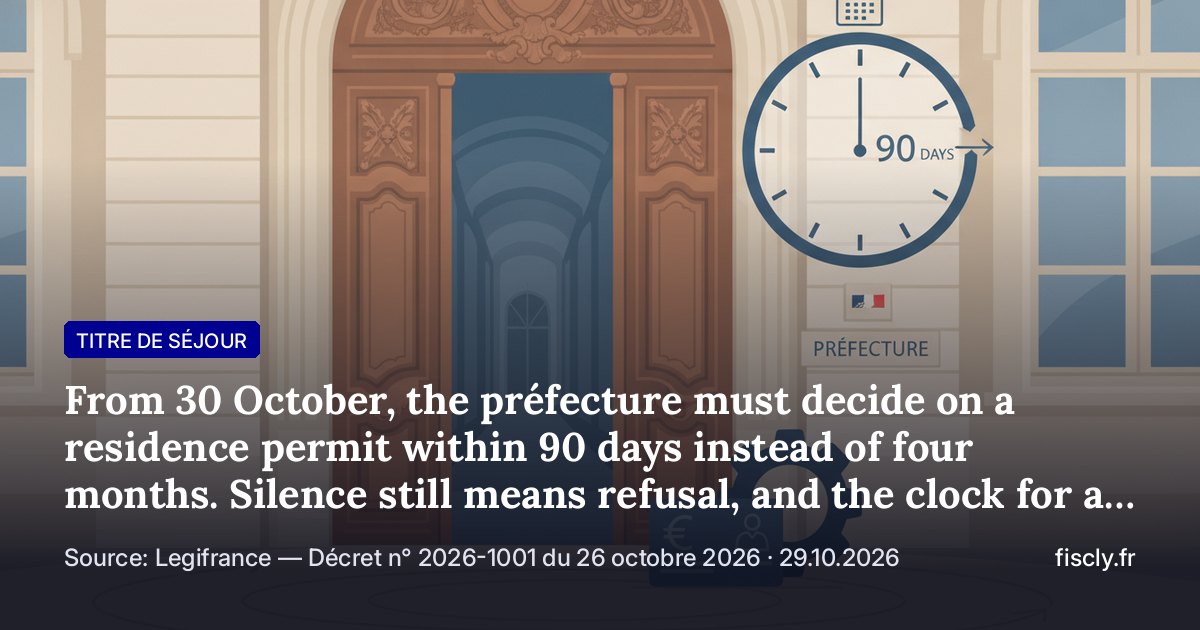
Decree no. 2026-1001 of 26 October 2026 was published in the Journal officiel on 29 October and took effect the next day, 30 October. It brings three EU directives into French law: the 'single permit' directive (2024/1233), the EU Blue Card directive (2021/1883) and the intra-corporate transfer (ICT) directive (2014/66). For most people applying for a carte de séjour, the part that matters is the new deadline for the préfecture's answer.
The main change: 90 days instead of four months
Under the new wording of article R. 432-2 of the CESEDA, the decision on a carte de séjour application must be notified in writing no later than 90 days after a complete application is filed. Before, the préfecture had four months: the decree's explanatory note says the deadline is cut 'from four months to ninety days'.
Three details matter:
- The clock starts when the application is complete. If the préfecture has not accepted the file as complete, the count does not run.
- It can be extended by 30 days when the application raises 'elements of particular complexity'. The préfecture must tell the applicant.
- Silence still means refusal. With no answer, an implicit refusal (décision implicite de rejet) arises after the same 90 days. For a few categories of cards the decree keeps specific deadlines, listed in separate CESEDA articles.
Why this matters for anyone waiting for a card
An implicit refusal is still a decision, and it can be challenged. The service-public page on the 'vie privée et familiale' card (checked on 1 May 2026, when it still gave the four-month deadline) says that after an implicit refusal there are 2 months to file an administrative appeal (to the préfet or the interior minister), a court appeal before the administrative court, or both.
In practice, everything moves forward. The answer is due about a month earlier, the implicit refusal arises a month earlier, and the two months for an appeal start earlier too. A common mistake is to assume the préfecture is simply running late and to realise only once the appeal window has closed. So it is worth:
- Keeping the document that proves the date the complete file was filed, and counting 90 days from it.
- Watching your post and online account: if the préfecture extends the deadline by 30 days, it has to say so.
- Not putting off advice from a lawyer or a free legal clinic once 90 days (or 120 with an extension) have passed with no answer: the rules give 2 months to appeal.
⚠️ The decree has no transitional provisions: the text does not say which deadline applies to files lodged before 30 October. Anyone who applied earlier should check with the préfecture or a lawyer how the deadline is counted.
What else changes for people who work
- Job loss for 'travailleur temporaire' holders. The explanatory note links this protection to the 'travailleur temporaire' card. If someone loses their job through no fault of their own, the card cannot be withdrawn on that ground as long as the time without work adds up to no more than three months over the card's validity. The person can stay in France while a new work authorisation is processed. A further three months apply where the working conditions fall under the Criminal Code articles listed in the decree.
- Changing employer. In the Labour Code (R. 5221-36), the period after a work authorisation during which a change of employer is restricted is cut from 12 to 6 months. The restriction does not apply where the employer has seriously breached the terms of the employment relationship.
- EU Blue Card. With a contract of at least two years, the card is issued for the length of the contract, up to four years. With a shorter contract, it covers the contract plus three months, up to two years. If renewal is refused or the card is withdrawn because the employer failed in its obligations, the holder gets six months to look for work. That period can run until unemployment benefit ends. Moving from another EU country now requires 12 months there instead of 18, or 6 months from the second move.
- UK employers. Employees of a British company posted to France to provide services can now work without a work authorisation for up to 12 months in total. The conditions: sectors to be set by a separate order (arrêté), one year with that employer and three years of experience.
- ICT cards. 'Salarié détaché ICT' and 'stagiaire ICT' cards require an annual gross salary at least equal to an average reference salary to be set by order.
Where to check
The decree is on Legifrance (link below). When this post was prepared, service-public pages on residence cards still showed the four-month deadline. Where a page and the decree differ, the decree published in the Journal officiel prevails. We do not assess individual situations: when a deadline decides someone's right to stay, a lawyer or legal clinic is the place to go.
Fiscly is an educational tool to help you understand the French tax system. It is not a substitute for professional tax advice. Tax situations are individual — always verify with impots.gouv.fr or a qualified accountant (expert-comptable) for your specific case.