Rail equipment set on fire in Toulouse, trains halted: what EU rules guarantee passengers after sabotage — and what they don't
Overnight on 21 October a fire near Empalot stopped trains around Toulouse-Matabiau. How sabotage differs from a strike for passengers: refunds and rerouting still apply, delay compensation may not.
What happened
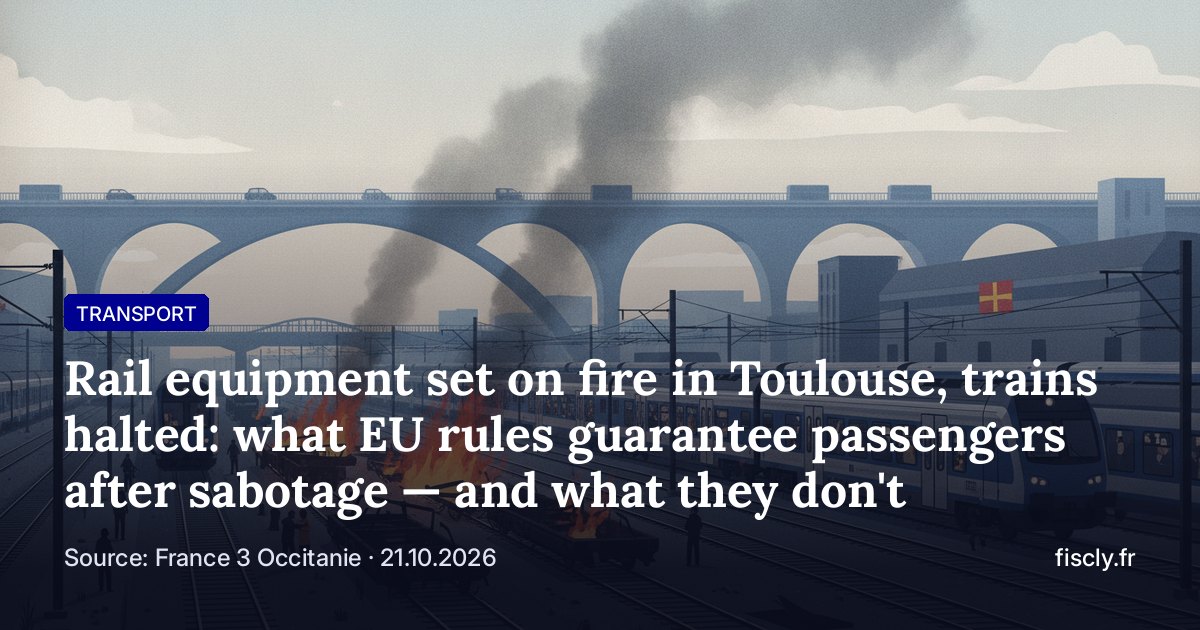
Overnight from Tuesday to Wednesday, 21 October, rail equipment caught fire in the Empalot area of Toulouse. According to SNCF, the fire damaged track installations and signalling, and traffic stopped. France 3 Occitanie describes it as vandalism and reports that it is the second incident of this kind in under a week.
The situation on Wednesday morning, according to the same source:
- no trains in either direction between Toulouse-Matabiau and Saint-Cyprien-Arènes, Muret and Auterive;
- trains into Toulouse from Luchon, Auch, Foix, Latour-de-Carol, Boussens, Bayonne and Muret cancelled;
- delays and cancellations possible on other routes.
SNCF has put on replacement buses. Between Matabiau and Muret, passengers are advised to use Tisséo city buses and the metro. Updates are posted on the liO Occitanie WhatsApp channel. SNCF expects normal service to resume on Thursday morning, 22 October. That is an estimate, not a guarantee: signalling repairs can overrun.
Sabotage and strikes are not the same thing for a passenger
Rail passenger rights in the EU are set by a common regulation, summarised on the EU's official Your Europe portal. The key point right now: the rules treat a disruption caused by third parties differently from one caused by the operator.
Your Europe lists as "extraordinary circumstances" extreme weather, major natural disasters and pandemics, as well as events caused by outsiders: people on the tracks, cable theft, sabotage, terrorism, police action. When a delay results from such circumstances, the operator may not have to pay cash compensation for the delay. By contrast, a strike by railway staff is explicitly NOT an extraordinary circumstance.
Whether a specific fire qualifies is for the operator to assess, and disputed cases go through the complaint route below. Still, it helps to know in advance that after an arson attack, "no compensation" is a possible answer and one the rules allow.
What applies regardless
Even in extraordinary circumstances, according to Your Europe, passengers keep:
- A choice when a train is cancelled or 60+ minutes late. If a train is cancelled or arrival at the final destination will be more than an hour late, the passenger can choose one of three options: a refund (within 30 days), continuing or rerouting at no extra cost as soon as possible, or travelling later on a date of their choosing.
- Self-rerouting. If the operator has not offered options within 100 minutes of the scheduled departure, passengers may take other public transport themselves, and the operator must reimburse reasonable costs.
- Assistance on the spot. For waits of 60 minutes or more, meals and refreshments in proportion to the wait; if an overnight stay is needed, a hotel and transport to it, "where and when physically possible".
For comparison: when a delay is not due to extraordinary circumstances, compensation is 25% of the ticket price for a delay of 1 to 2 hours and 50% for more than 2 hours.
A caveat for regional trains
Your Europe notes that a country may exempt urban, suburban and regional services, as well as domestic long-distance trains, from some of the rules. Only international journeys between EU countries cannot be exempted. The suburban lines around Toulouse are liO regional trains, so the exact refund and compensation terms there are worth checking in the operator's own conditions rather than relying on the general regulation alone.
How to complain
- First to the operator, within 3 months of the incident. It must reply within one month, or three in duly justified cases.
- No reply, or an unsatisfactory one: within 3 months, passengers can turn to the national authority that licensed the operator. Its opinion is not binding.
- Other routes exist: out-of-court dispute resolution, the European Small Claims Procedure, European Consumer Centres.
- The EU has a common refund and compensation request form. Using it is optional: operators may have their own forms and deadlines.
In practice
- Before setting off on Thursday, it is worth checking the train's status on the liO Occitanie channel or the SNCF app: "Thursday morning" is SNCF's estimate, not a promise.
- Keep tickets, proof of the cancellation and receipts for taxis or other transport: these are what go with a claim for reimbursed costs.
No further developments have been announced. The source does not name any investigation or culprits, and neither do we.
Fiscly is an educational tool to help you understand the French tax system. It is not a substitute for professional tax advice. Tax situations are individual — always verify with impots.gouv.fr or a qualified accountant (expert-comptable) for your specific case.