Ain and Jura on orange 'rain-flood' alert for 22–23 November 2026. The 72-hour emergency kit: what the official list includes and where to keep it
Météo-France raised the Ain and Jura to an orange 'pluie-inondation' alert for 22–23 November 2026. What the guidance says at orange and red level, and how to put together a kit d'urgence 72 h from the government's list.
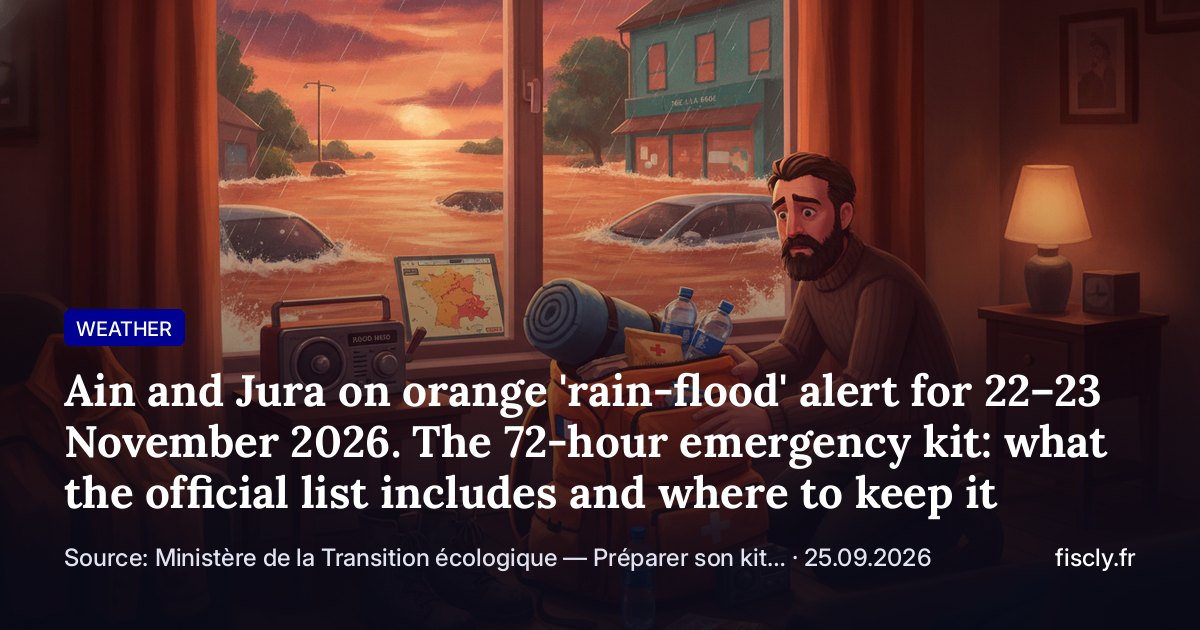
What happened
Météo-France has put the Jura (39) and Ain (01) départements on an orange 'pluie-inondation' (rain and flooding) alert covering 22 to 23 November 2026. According to Météo-France's morning bulletin, in the Ain the episode starts at 16:00 on 22 November; the areas concerned are the eastern massifs — the south of the Jura and the east of the Ain, where a new weather front is holding the rain in place.
Based on Météo-France data reported by franceinfo, this level can bring serious flooding in areas that usually flood, difficult driving on secondary roads, and power cuts. End times and the map itself can change: the live status is on vigilance.meteofrance.fr.
We covered what the alert colours mean, and what the rules say about work on such a day, earlier this autumn. Today's focus is something Météo-France mentions in a single line of its advice and that newcomers rarely think about in advance: the 72-hour emergency kit.
What the advice says at orange level
Météo-France's guidance for an orange 'pluie-inondation' alert:
- keep away from rivers and low-lying ground; move to high ground or an upper floor;
- do not drive onto a flooded road, even if it is only partly under water;
- avoid travelling if you can, stay informed and watch the water level;
- do not go down into basements or underground spaces;
- move belongings above the water line and check where your kit d'urgence is.
If the alert is raised to red, the list gets stricter: stay at home and follow the authorities' instructions, do not use the car, do not go to collect children from school, keep away from rivers, low ground and bridges, move upstairs if needed (onto the roof only as a last resort), and evacuate only when the authorities order it — taking that same kit.
The 72-hour kit: the official list
The ecology ministry keeps a dedicated page on the kit d'urgence 72 h. As it describes it, the kit lets you wait safely at home until help arrives, and it is also useful if you have to leave in a hurry. The list includes:
- drinking water — 6 litres per person, in sealed containers;
- non-perishable food that needs no cooking;
- a torch with batteries, or a wind-up one;
- a pocket knife or a tin opener;
- candles with matches or a lighter;
- a phone charger;
- a spare pair of glasses;
- a battery-powered radio and spare batteries;
- a first-aid kit and medicines;
- a spare set of keys;
- photocopies of identity documents;
- cash;
- warm clothes;
- games to pass the time.
The ministry advises keeping the kit somewhere easy to reach but out of the water's way — it says explicitly that a cellar or basement is not the place. The contents should be topped up and renewed once a year.
What this means for newcomers
- For a foreign resident, 'copies of identity documents' means first of all the passport and the residence permit (or récépissé). Keeping copies in a waterproof bag alongside the kit is a simple way not to be left without them if you need to leave your home quickly.
- A radio, a torch and cash are not old-fashioned. Météo-France itself lists power cuts among the possible effects of an episode like this one, and without electricity the router and phone charging stop working.
- A common mistake is keeping supplies with everything else: in the cave or in a storage box in an underground car park. Those are exactly the places the advice says not to go down to during a flood, and where the ministry says not to store the kit.
- The kit is put together in advance, not on alert day. The point of the list is that when danger comes you only have to pick it up — and once a year, check the expiry dates and the batteries.
An orange alert is a signal that the danger is real and that preparing makes sense while the roads are still open and the power is still on.
Fiscly is an educational tool to help you understand the French tax system. It is not a substitute for professional tax advice. Tax situations are individual — always verify with impots.gouv.fr or a qualified accountant (expert-comptable) for your specific case.