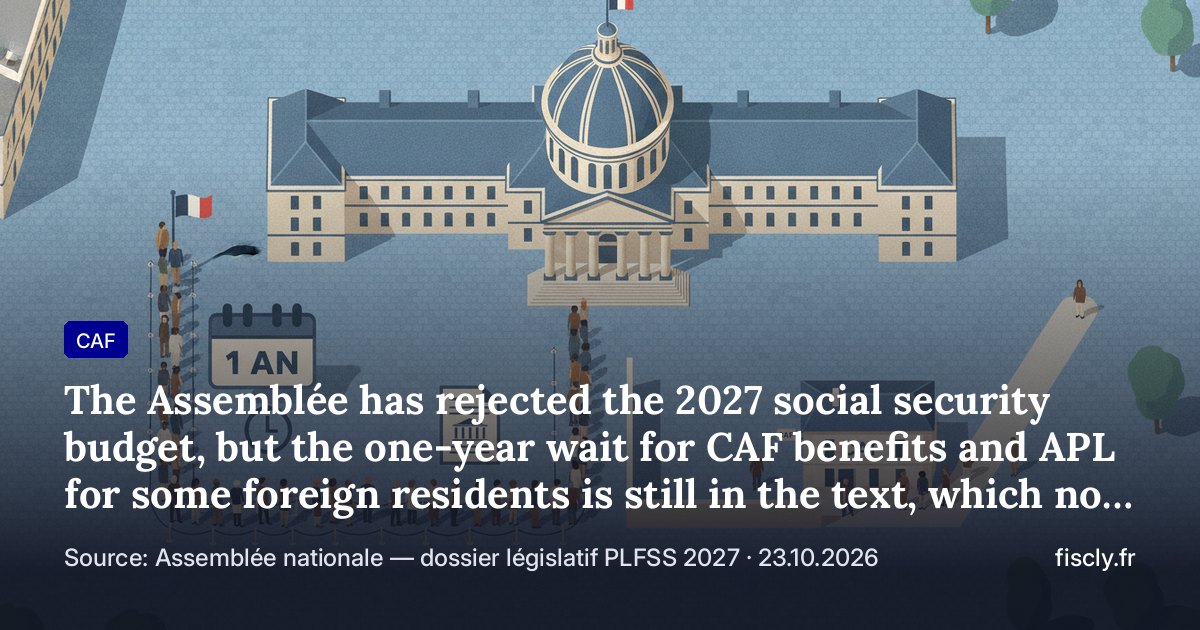
The Assemblée has rejected the 2027 social security budget, but the one-year wait for CAF benefits and APL for some foreign residents is still in the text, which now goes to the Senate. What is proposed, and what the rules are today
MPs threw out the PLFSS 2027 without ever reaching article 37, which sets a one-year residence wait for family benefits and housing aid. How the Sécu budget goes through Parliament, why a rejection in the Assemblée does not kill the measure, and which documents CAF asks foreign residents for today.
What happened
The government tabled the 2027 social security financing bill (PLFSS 2027, no. 3211) in the Assemblée nationale on 1 October 2026. On 23 October, MPs rejected it at first reading, according to the bill's file on the Assemblée website.
According to NosParlementaires, the deciding vote was on the first part, which covers revenue: 115 against, 1 in favour, 22 abstentions. That sank the whole text, so MPs never got to the second part, on spending. The formal vote planned for 27 October became pointless.
One article matters most to foreign residents: article 37. MPs never debated it or voted on it, so it stays in the text exactly as the government wrote it.
What article 37 proposes
As LCP describes it, the measure would make nationals of non-EU countries wait until they have lived legally in France for one year before they can receive:
- PAJE (the benefit for a birth and for young children), allocations familiales and complément familial;
- allocation de soutien familial and allocation de rentrée scolaire;
- housing aid: allocation de logement and APL.
Some payments are left out, such as the allowance for a disabled child (AEEH).
Again according to LCP, the waiting period would not apply to:
- citizens of the EU, the EEA and Switzerland;
- people with international protection;
- holders of a carte de résident;
- foreign residents whose permit allows them to work;
- nationals of countries that have a social security agreement with the EU or with France.
LCP gives no date for the measure to take effect. For now it is a proposal, not a rule: nothing has changed in how CAF pays benefits today. In the end, what counts is the exact wording in the final law, not a press summary of it.
Why the MPs' rejection doesn't end the measure
The timetable for the Sécu budget is set by article 47-1 of the Constitution:
- The Assemblée has 20 days after the bill is tabled for its first reading. If it has not reached a decision by then, the government sends the text to the Senate, which has 15 days to decide.
- From there, it works like an ordinary law. The text goes back and forth between the two houses, and if they disagree, a commission mixte paritaire of 7 MPs and 7 senators is convened.
- If Parliament has not decided within 50 days, the government can put the bill's provisions into effect by ordonnance.
So the Assemblée's rejection does not settle the matter. According to NosParlementaires, citing an AFP dispatch, the Senate will start on the government's version of the bill from 9 November, and the 50-day deadline runs out on 26 November. The Senate's own file on the bill was updated on 27 October, but it does not yet show the text as received or give any debate dates.
What CAF asks for today
Under the current rules (service-public, "Vérifié le 16 octobre 2026"), a national of a non-EU country can receive family benefits if they live in France legally and can prove it with a document. Accepted documents include:
- a VLS-TS, the long-stay visa that counts as a residence permit;
- a carte de séjour temporaire or a carte de résident;
- an autorisation provisoire de séjour of more than 3 months.
For each of these, a récépissé (the receipt you get when you apply to renew) is also accepted.
The child must also live in France. A parent without a document that allows them to work must also show that the children entered France legally. An EU citizen only has to show a right of residence, for example as a worker, a student or a person not in work.
For allocations familiales specifically (service-public, "Vérifié le 1er juin 2026"), you need at least two dependent children under 20. You must live in France on a habitual basis or spend more than 9 months a year here. Payments are suspended if a child leaves for more than 3 months, apart from the cases the page lists.
What this means in practice
- Nothing has changed yet. The Assemblée's rejection does not change any benefit being paid now.
- The most common mistake is letting a permit lapse. CAF checks that your stay is legal, and a renewal récépissé satisfies that check. Applying to renew on time is the best protection, however the vote goes.
- Watch the final text. If the measure passes, everything will depend on the exact exemptions and the start date. Talks in the Senate and in the commission mixte paritaire can change both.
This is not advice on any individual situation: we describe what the rules provide and what the bill proposes.
Fiscly is an educational tool to help you understand the French tax system. It is not a substitute for professional tax advice. Tax situations are individual — always verify with impots.gouv.fr or a qualified accountant (expert-comptable) for your specific case.